Storstrøm Bridge (Storstrømsbroen): Queen Margrethe II's Bridge
From November 2022 to March 2026, KBT Waterproofing waterproofed the new Storstrøm Bridge between Masnedø and Falster with KBT Type 5 (Eliminator®): the carriageway, railway, emergency walkways and cycle path, 98,000 m² in total, plus 15,000 m² of Decseal on the footway and cycle path. Every section was documented for climate, adhesion, film thickness and a holiday test (spark test) at 12 kV, and on the best day 3,840 m² of the full system was applied.
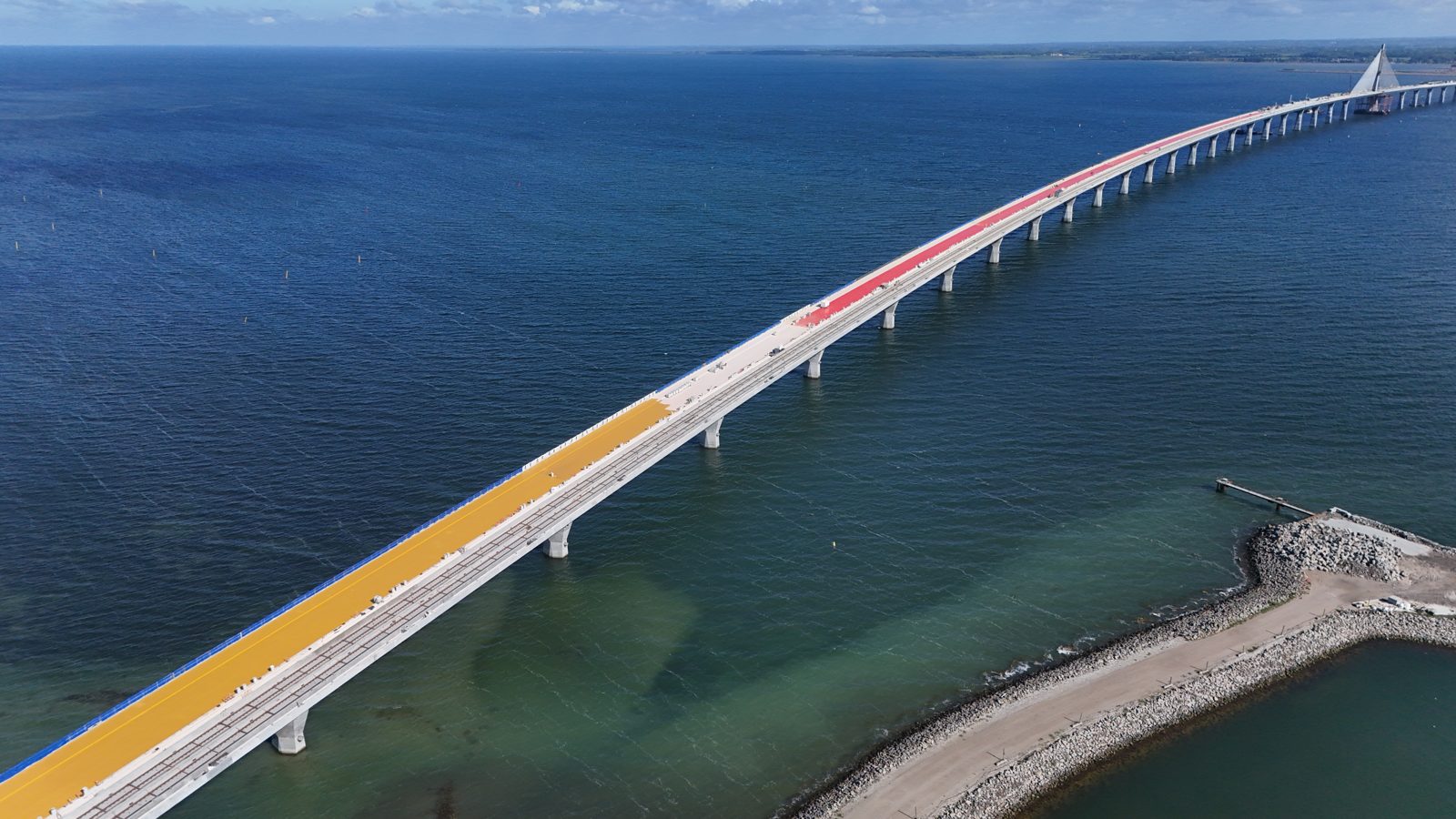
What was the scope on the Storstrøm Bridge?
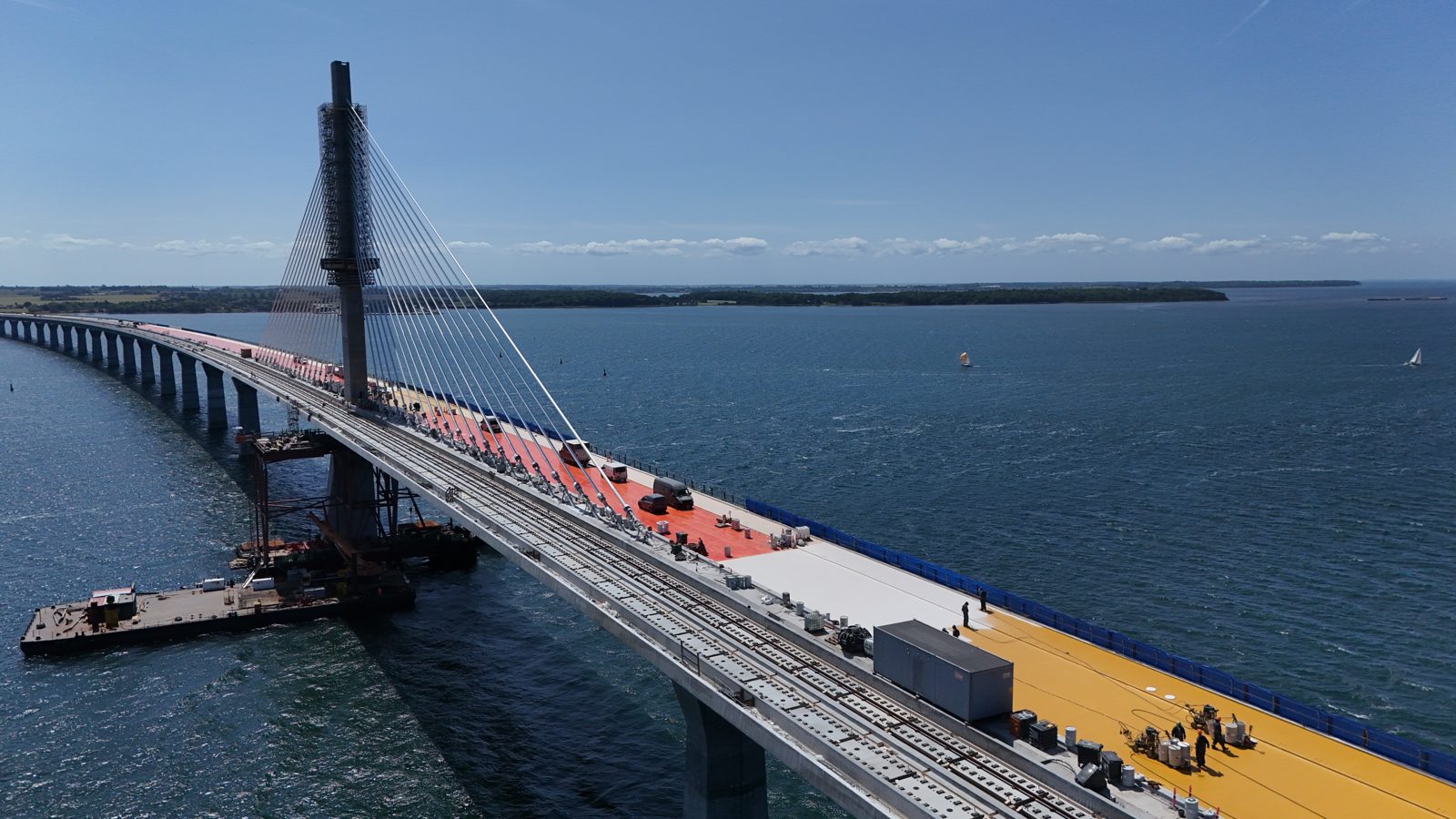
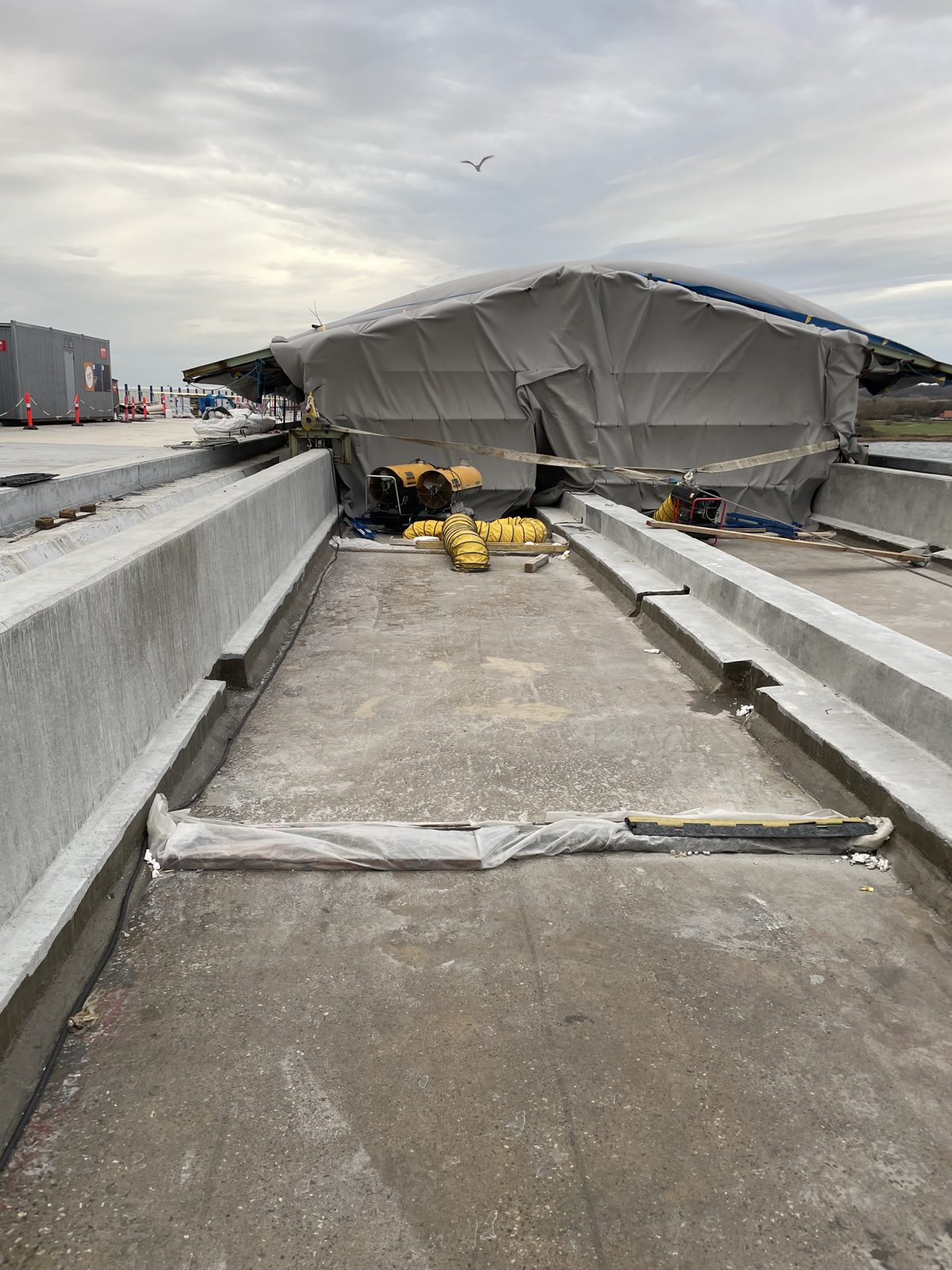
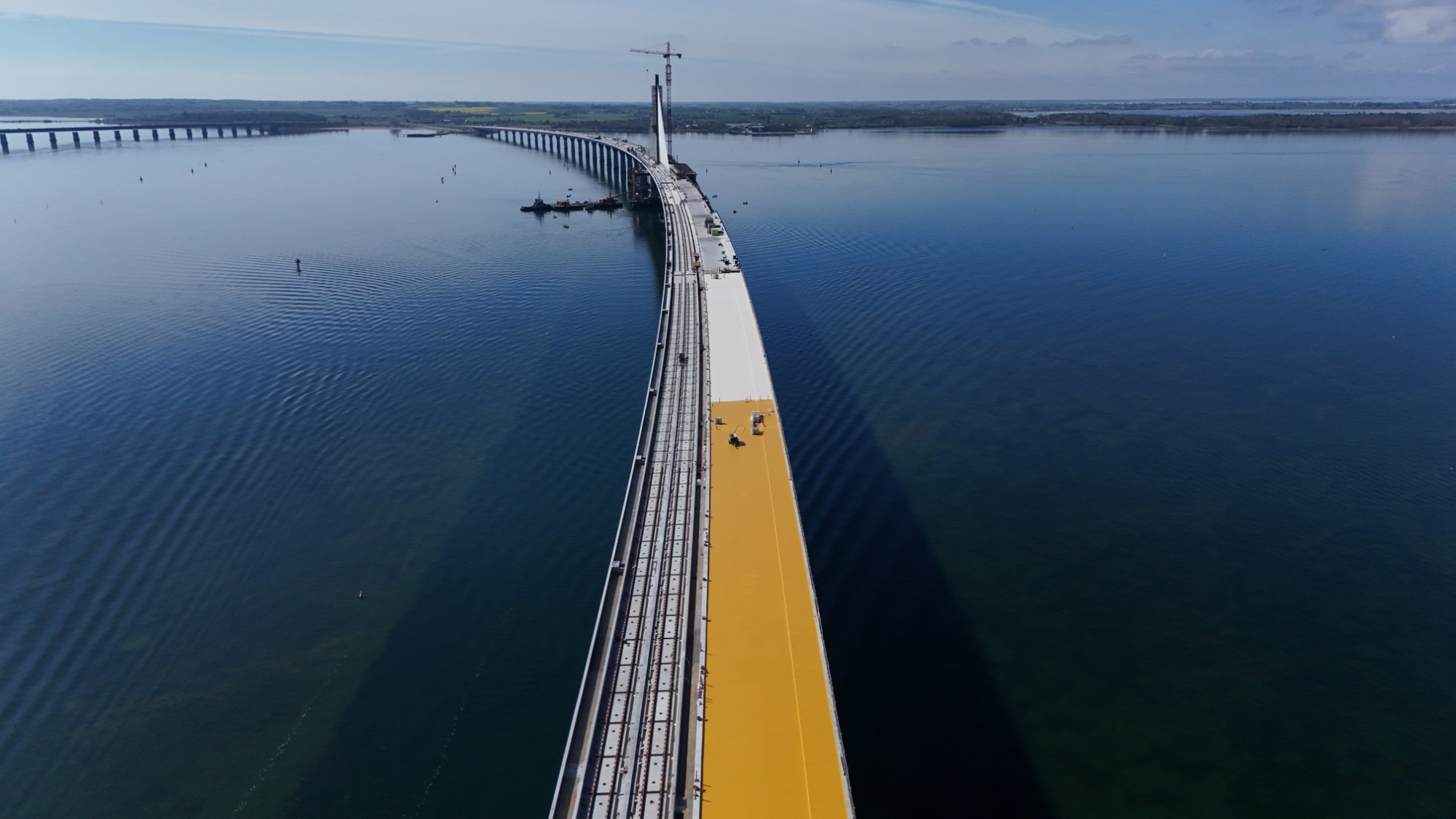
The new Storstrøm Bridge, today Queen Margrethe II's Bridge, is a cable-stayed bridge almost 4 km long between Masnedø near Vordingborg and Orehoved on Falster, carrying a double-track railway, a carriageway, a cycle path and emergency walkways. The bridge girders were cast on Masnedø and lifted into place, and KBT carried out the waterproofing both on land, before the girders were moved, and out on the bridge itself.
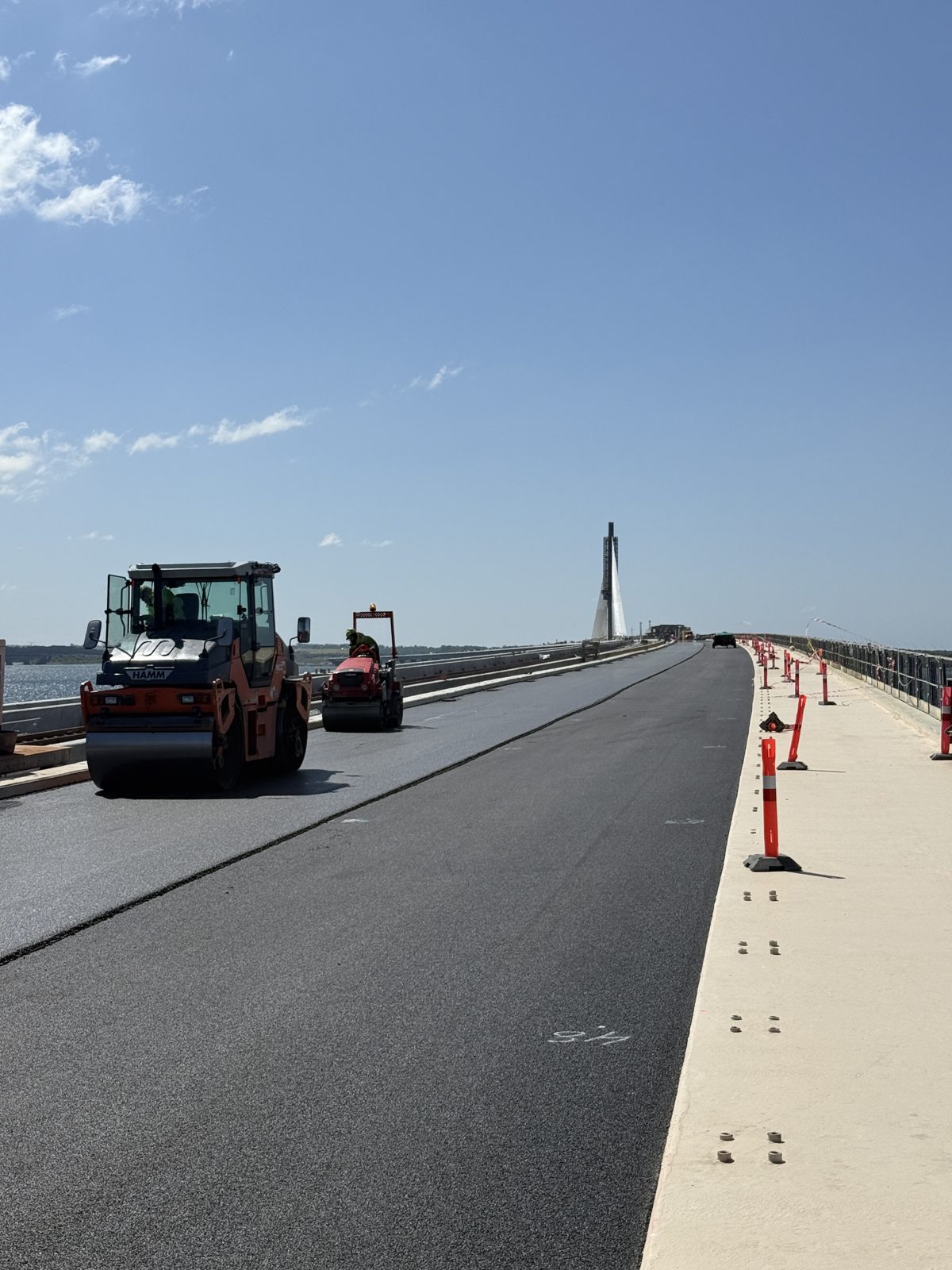
KBT Waterproofing was a subcontractor to Storstroem Bridge Joint Venture (SBJV), with the Danish Road Directorate (Vejdirektoratet) as client and COWI as the client's consultant. The scope comprised shot blasting, primer, two colour-coded membrane layers, bond coat beneath the asphalt on the carriageway and Decseal Wearing Course as the wearing course on the cycle path, together with full QA documentation of every section.
| Structure | Storstrøm Bridge (Storstrømsbroen) / Queen Margrethe II's Bridge, Masnedø–Orehoved (Falster) |
|---|---|
| Client | The Danish Road Directorate (Vejdirektoratet) |
| Client's consultant | COWI |
| Main contractor | Storstroem Bridge Joint Venture (SBJV), works executed by Itinera |
| Membrane system | KBT Type 5: Eliminator® (two-component MMA, cold spray-applied), GCP Applied Technologies |
| Membrane | 98,000 m² of KBT Type 5 on the carriageway, railway, emergency walkways and cycle path |
| Wearing course, footway and cycle path | 15,000 m² of Decseal Wearing Course, grey, with anti-slip aggregate |
| Execution | November 2022 – March 2026 (on land 2022–2023, on the bridge 2024–2025, Decseal September–October 2025) |
| Documentation | QA report per girder and area, sent to SBJV no later than the day after the work was carried out |
Why was KBT Type 5 chosen for the Storstrøm Bridge?
Because the system could be documented before the contract was signed, and because it had already been tried on site. During the tender in autumn 2022, KBT demonstrated to SBJV that Eliminator meets the project requirements, with a complete documentation package:
- European Technical Assessment (ETA) for the two-layer Type V system and the manufacturer's factory production control.
- Ageing tests and a documented expected service life of 120 years.
- Previous approval by the Danish Road Directorate and KBT's own references, such as the Old Little Belt Bridge (Gl. Lillebæltsbro, 7,000 m²).
- A requirements matrix linking each requirement in the tender to a documented test result.
SBJV was also familiar with the system beforehand. In 2018 KBT applied 500 m² on the underpass at Orehoved as a trial area, and in September 2022 KBT carried out pull-off tests on the first five cast bridge girders before production began. The decision was therefore based on measurements from the bridge's own concrete, not just on a data sheet.
Two properties carried particular weight in practice: year-round application, because Eliminator cures in 30–60 minutes and can be applied at low temperatures, and instrument-based verification of watertightness, because a seamless spray-applied membrane can be holiday tested electrically across its entire surface. Read more about bridge deck waterproofing with KBT Type 5 and holiday testing.
How is the membrane built up on the road, railway and cycle path?
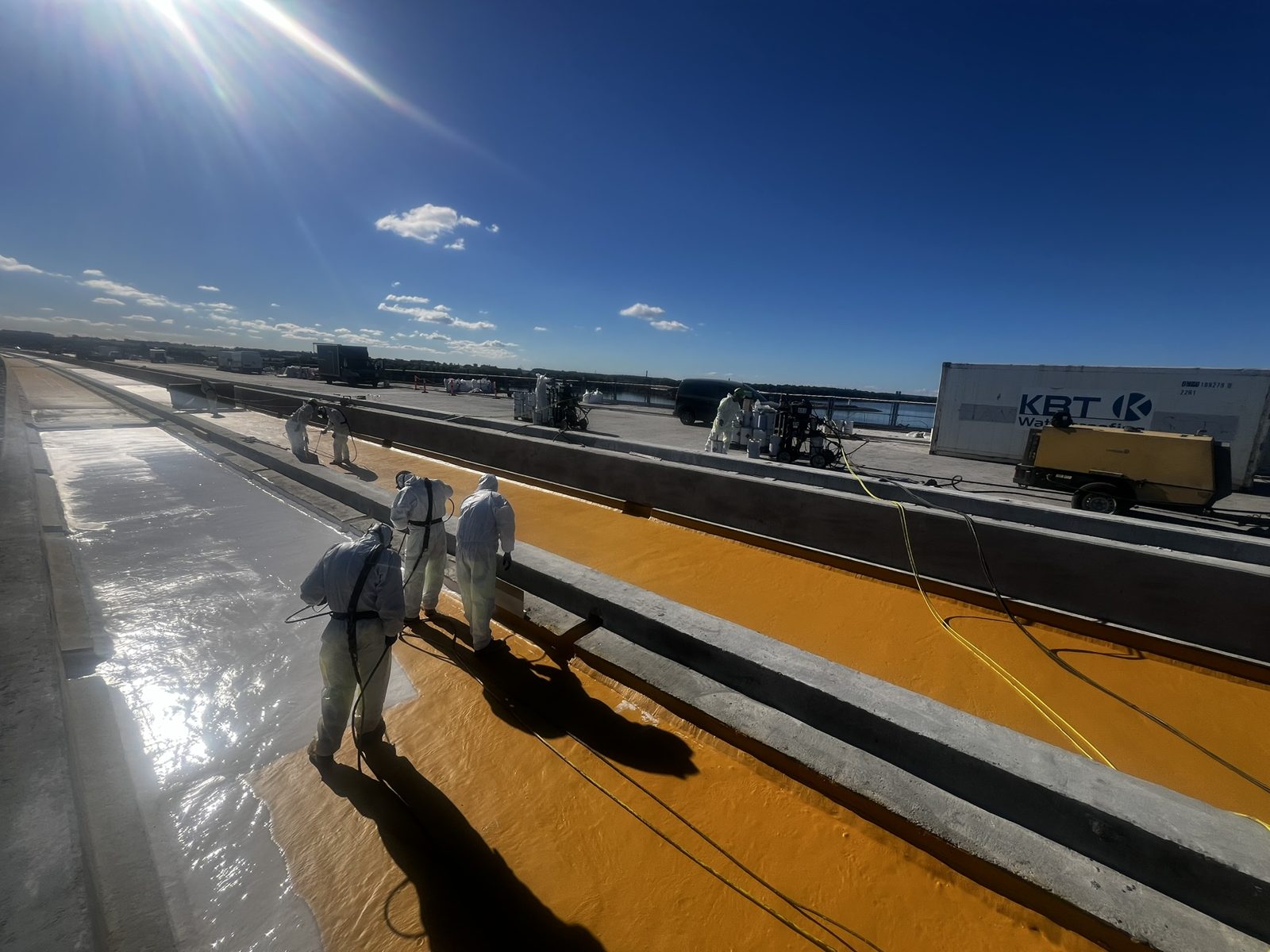
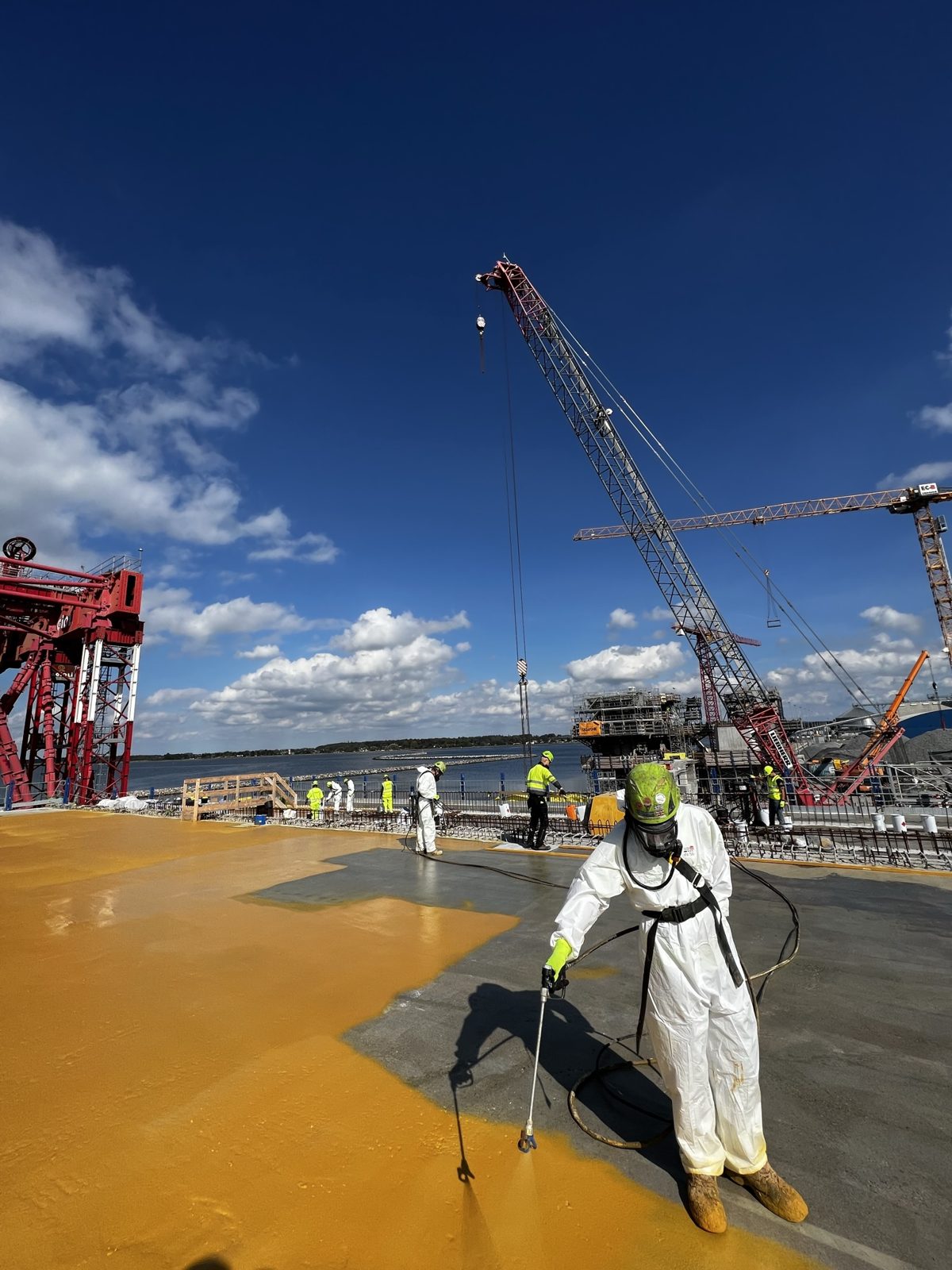
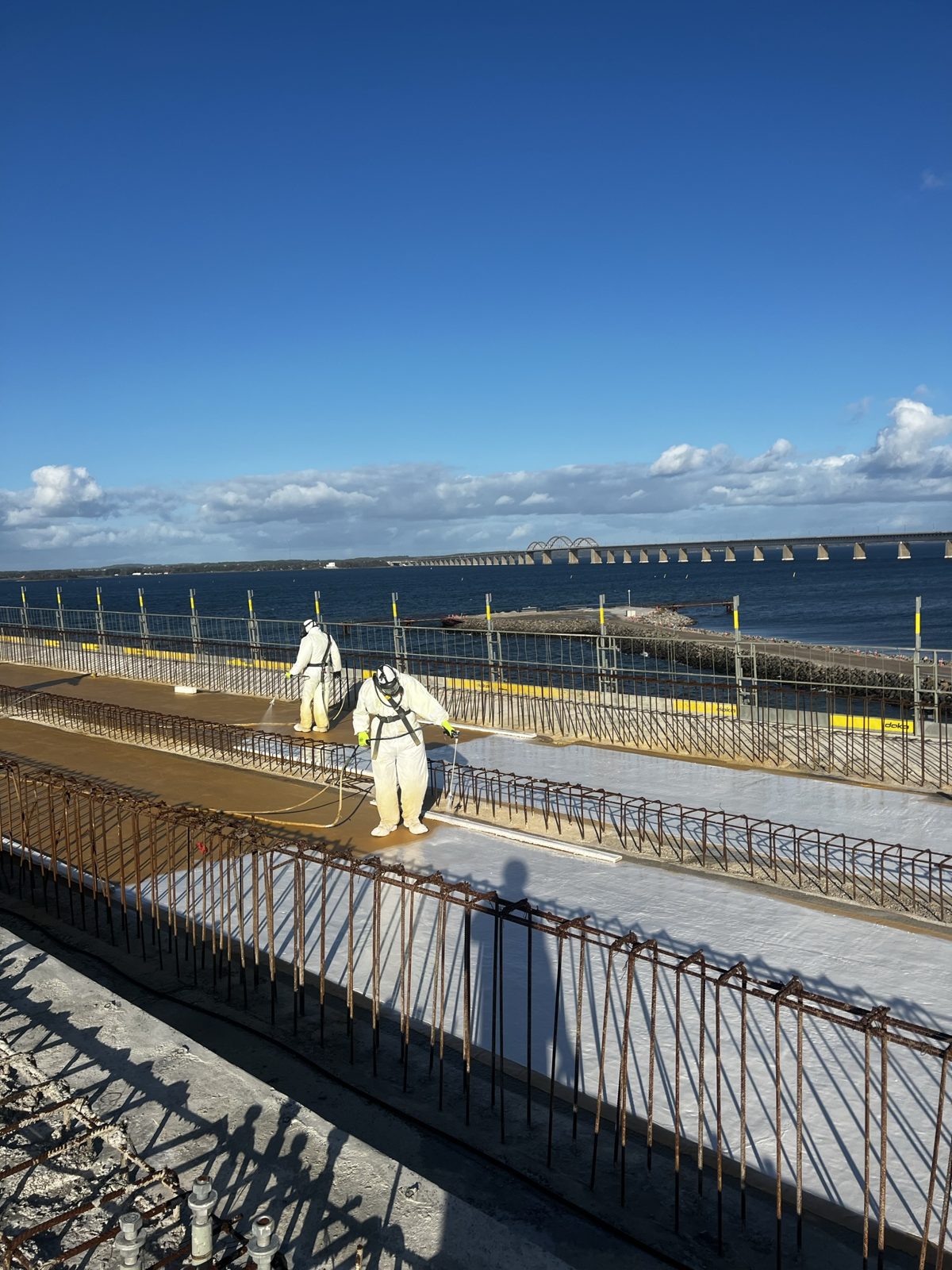
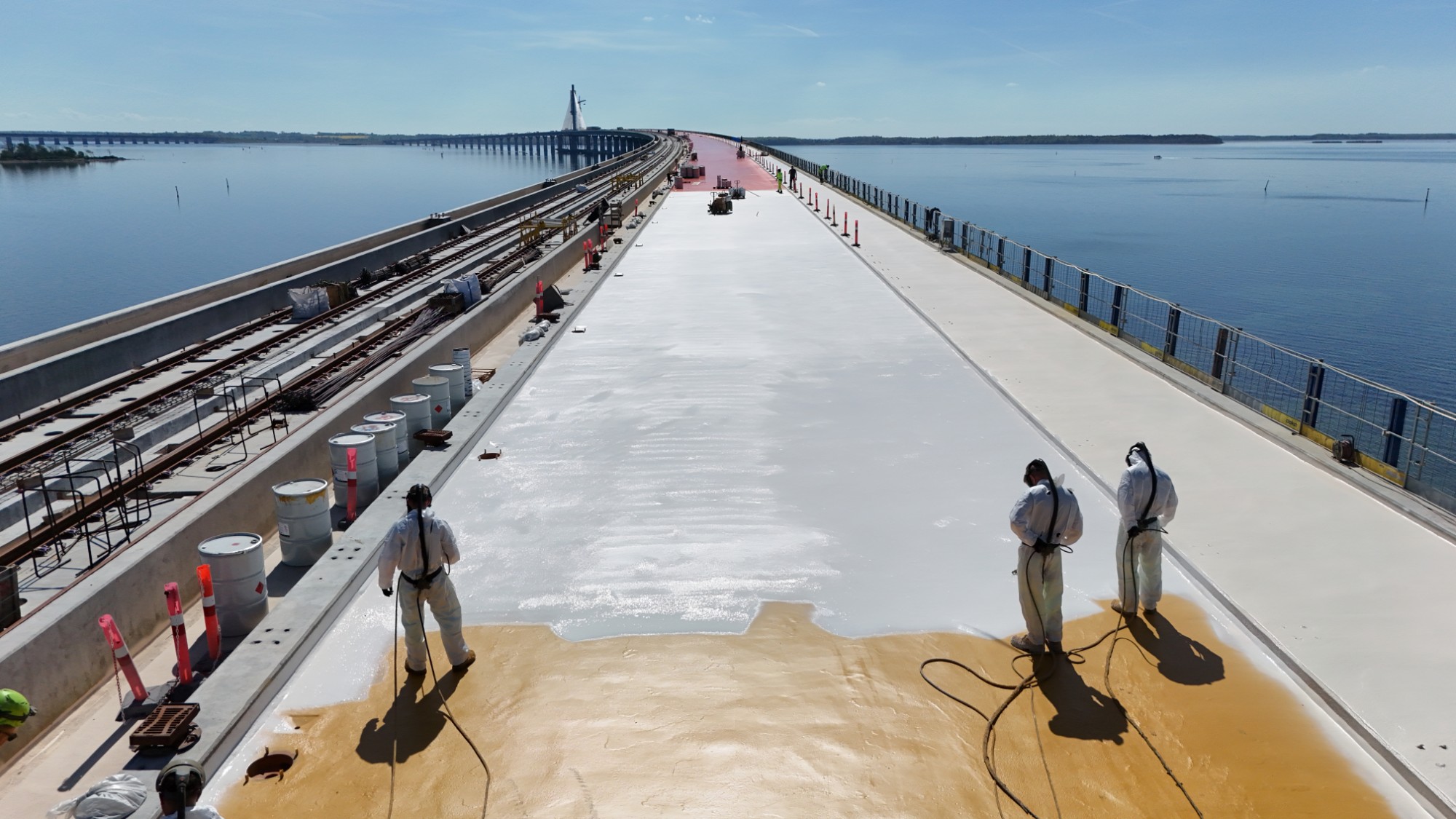
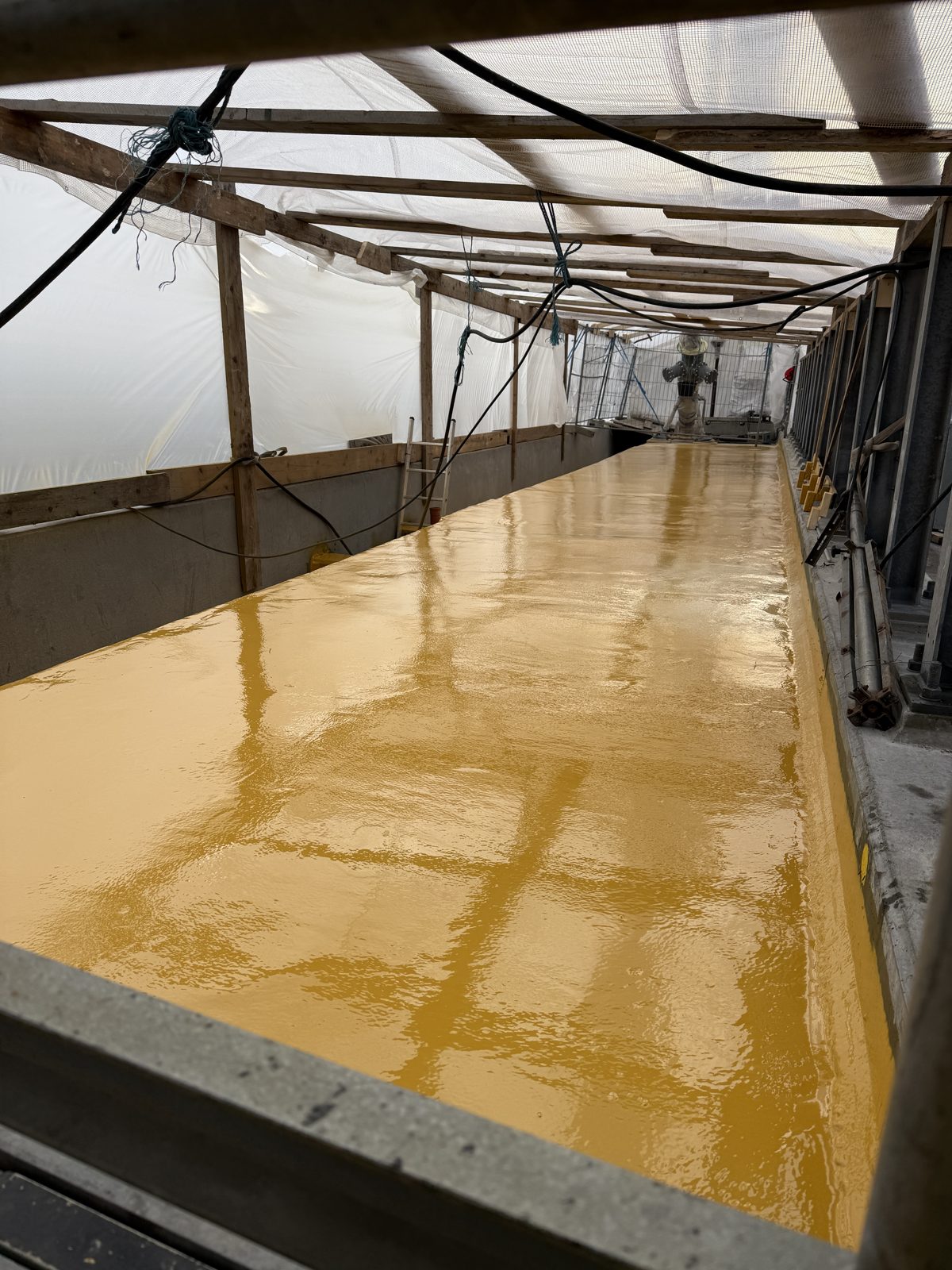
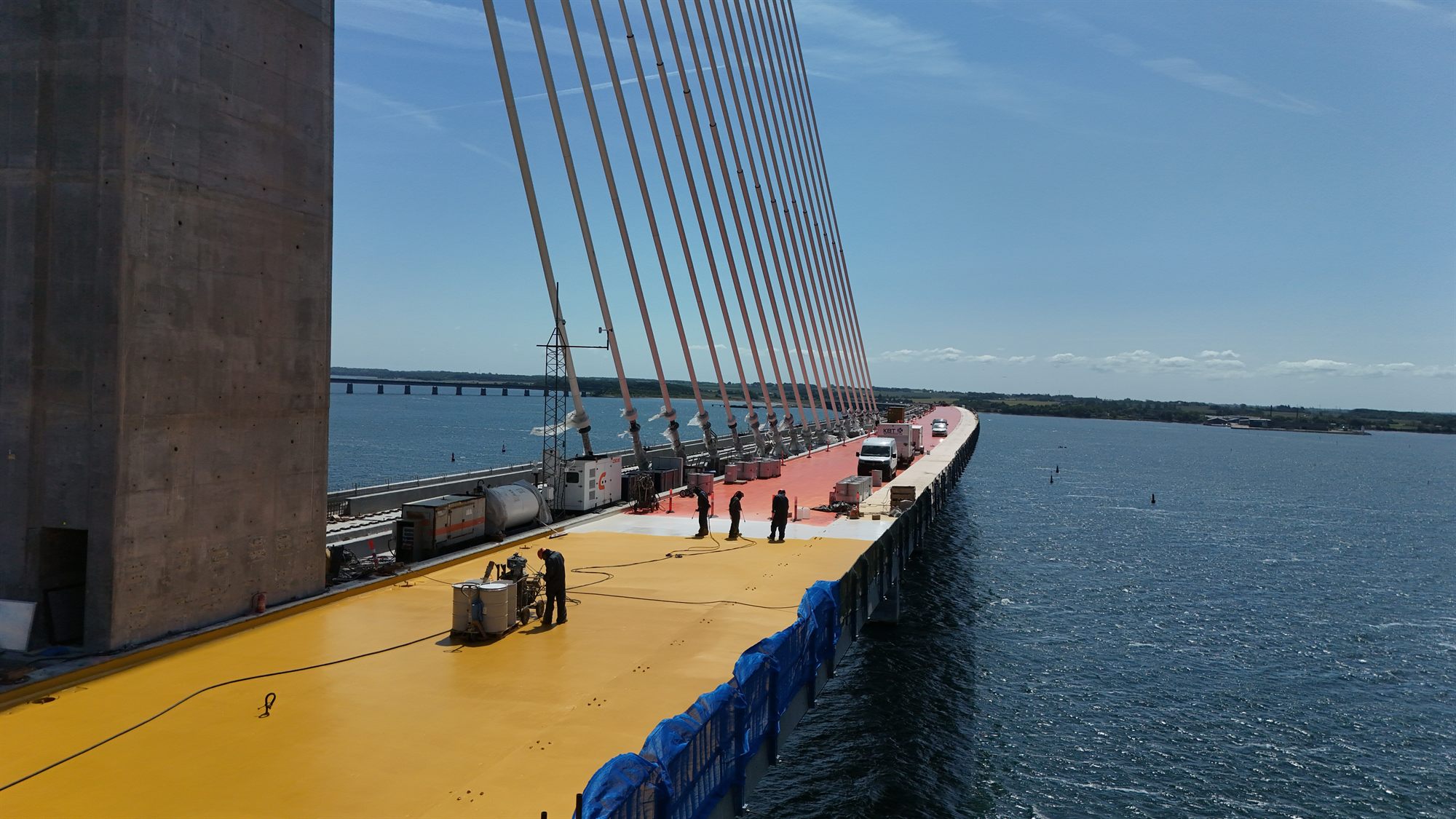
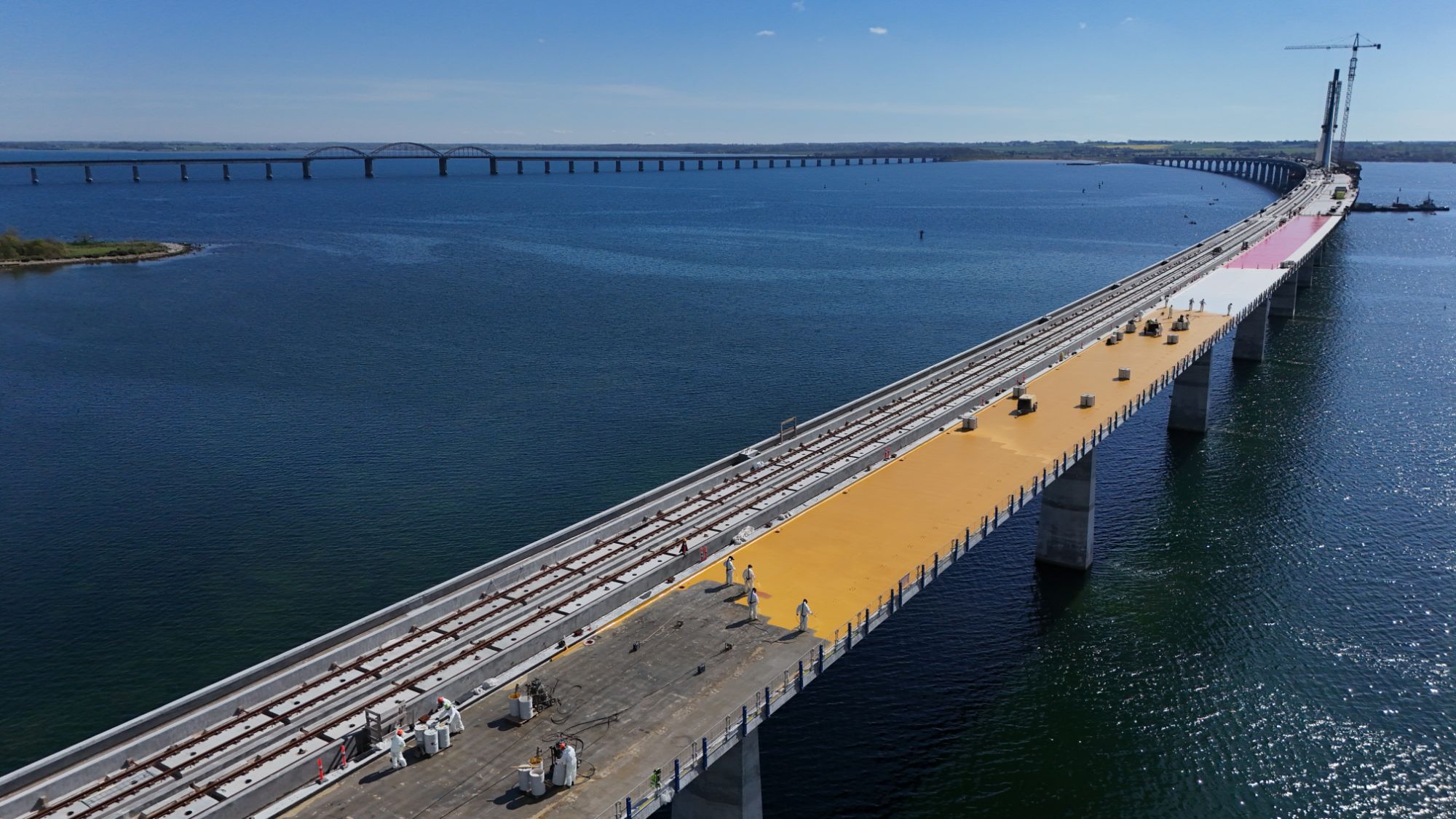
The build-up is tailored to each area. The railway and emergency walkways received the thickest membrane, because no asphalt is laid on top. The carriageway received bond coat as a tack coat for the asphalt, and the cycle path received Decseal as its finished wearing course. All layers are colour-coded so that coverage can be checked visually: a yellow first layer, a white second layer and a red bond coat.
| Area | Primer | 1st layer (yellow) | 2nd layer (white) | Finish |
|---|---|---|---|---|
| Carriageway | PAR1 | 1.0 mm | 1.5 mm | Bond Coat No. 3, approx. 0.5 mm, followed by asphalt |
| Railway | PAR1 | 1.5 mm | 1.5 mm | The membrane is the finished surface beneath ballast/track |
| Emergency walkway | PAR1 | 1.5 mm | 1.5 mm | The membrane is the finished surface |
| Cycle path | PAR1 | Membrane | Membrane | Decseal Wearing Course with anti-slip aggregate |
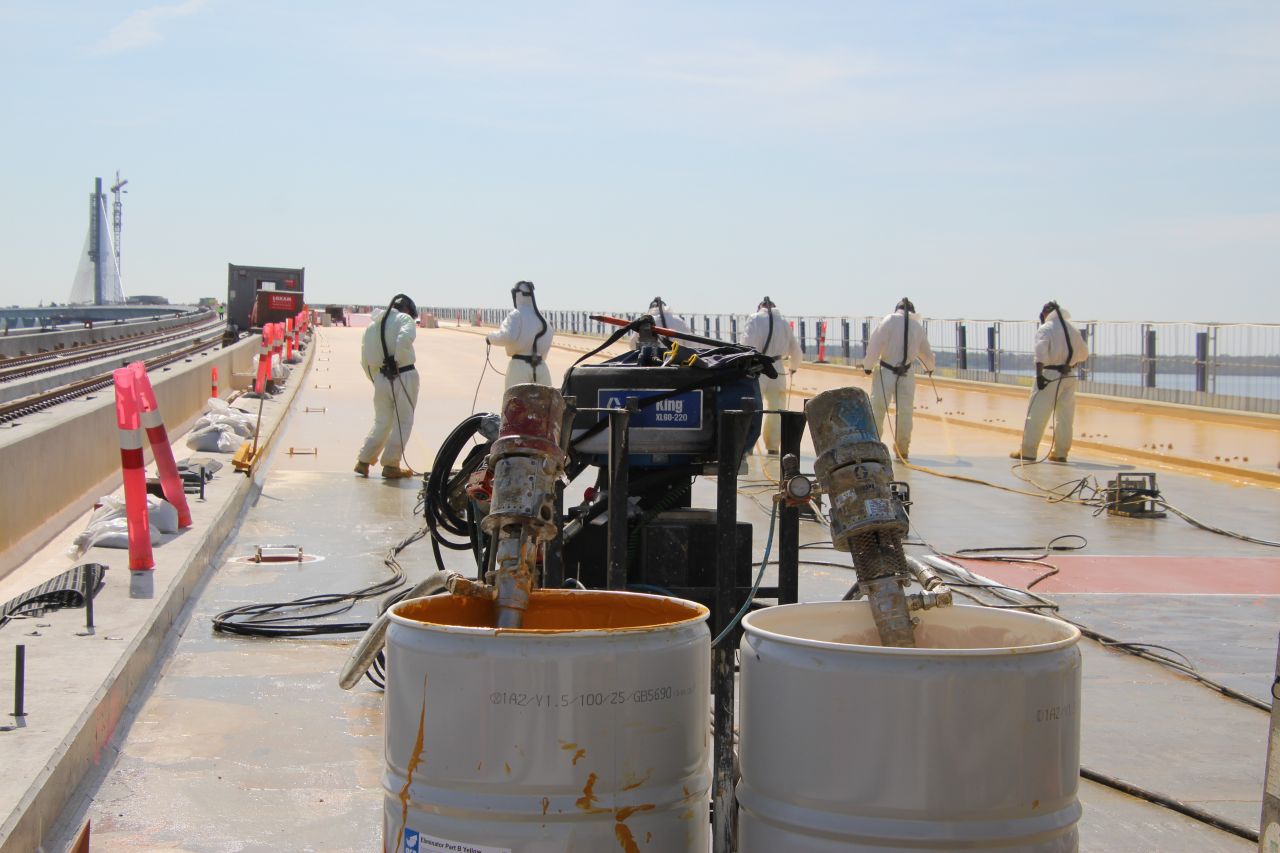
The thicknesses are dry film thicknesses in accordance with KBT's method statement for the project. Steel surfaces were primed with Zed S94. The material was sprayed using air-driven Graco pumps (1–3 per crew), and consumption was checked against the specified rate for each component.
How did KBT achieve 3,840 m² in one day?
By having the whole chain ready at the same time: shot blasting, primer, two membrane layers and bond coat, with a separate QA crew testing behind the spray crew. On 25 April 2025, four road girders (G9N, G10N, G11N and G12N, 960 m² each) received the full system in a single day. That is 3,840 m², documented in four QA reports dated the same day.
The entire northern carriageway, 16 girders and 15,360 m², was completed between 24 April and 1 May 2025. Across 2025 as a whole, the average was 1,500–2,000 m² per working day, because the work followed the progress of the bridge and the weather. The capacity of more than 3,000 m² a day is therefore not a theoretical figure but one measured on a real bridge, and it is the reason KBT can make use of short windows when they arise.
The QA crew spent 3–4 hours a day on measurements, and the report for each girder was sent to SBJV no later than the following day. The asphalt could therefore follow directly behind the membrane without waiting for documentation.
How was every square metre verified?
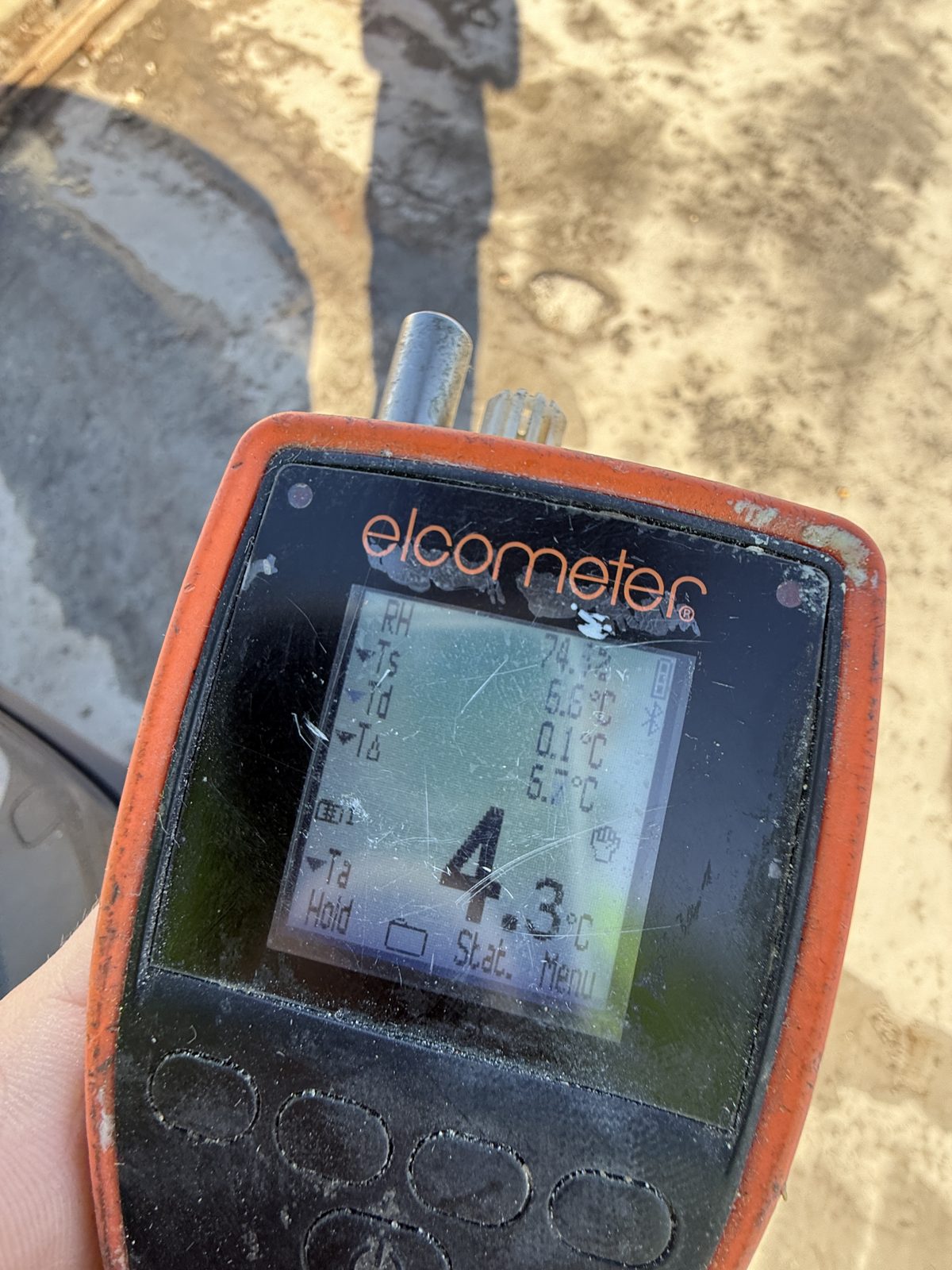
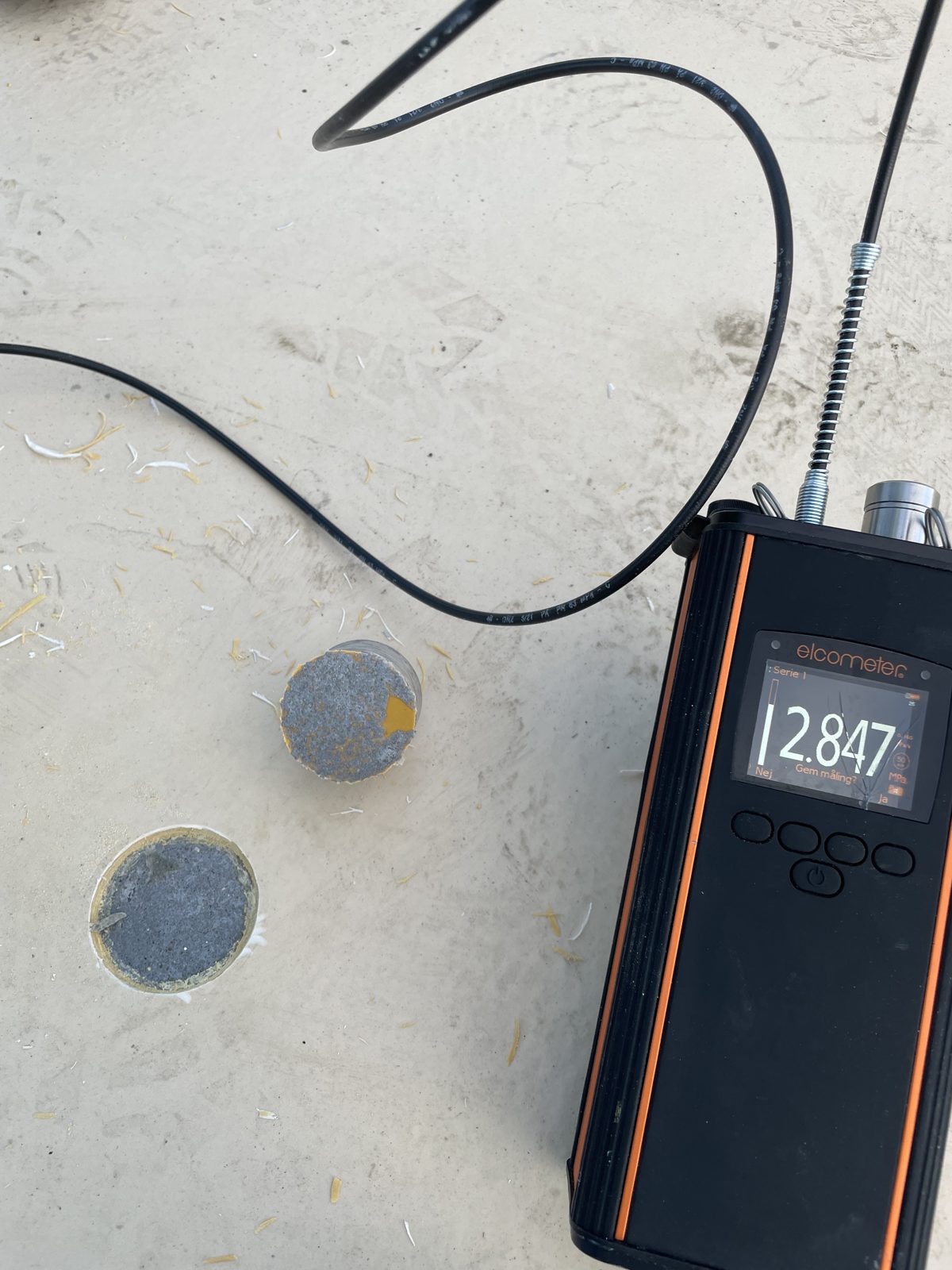
The requirements were set out in the method statement, and each section was released on the basis of measurements. The climate had to be within +4 to +30 °C, with the surface at least 3 °C above the dew point, relative humidity below 90% and wind below 10 m/s. Adhesion was measured before and after application with a digital Elcometer and 50 mm dollies, with at least three pull-off tests per 500 m². Dry film thickness was measured at least every 5 m², and the entire area was holiday tested at 12 kV.
The test voltage follows the total membrane thickness. The thicker the film, the higher the voltage needed for the spark to break through a pore and trigger the alarm. On the Storstrøm Bridge the membrane is up to 3 mm dry film thickness, so the holiday test was carried out at 12 kV, higher than the 10 kV typically used for thinner build-ups.
| Check | Result | Requirement |
|---|---|---|
| Pull-off tests, 61 QA reports 2024–25 (38,130 m²) | 409 tests, 1.5–4.0 MPa, average 2.85 MPa | Average ≥ 2.0 MPa, none below 1.5 MPa |
| Holiday test, same 61 reports | 789 holidays (pinholes) found, all repaired and retested | 12 kV across the entire area |
| Example: emergency walkway G16–14N, 18 June 2025 (1,020 m²) | Before: 2.3 and 3.8 MPa · After: 3.0–3.7 MPa with 100% failure in the concrete · 24 holidays, 24 repaired | As above |
| Emergency walkway G18S–G22S, March 2025 | Average per girder 3.00–4.01 MPa before and after | Average ≥ 2.0 MPa |
| Wet film, measured | 1.2–1.4 mm on the first carriageway layer · 1.9 mm per layer on the railway | In accordance with method statement |
| Climate during application | Air 3.2–29 °C, surface 3.8–29.6 °C, RH 26–87.5% | +4 to +30 °C, ≥ 3 °C above dew point, RH < 90% |
| Decseal, cycle path | 38 pull-off tests, 1.5–3.2 MPa · additional check Nov. 2025: 2.3–2.6 MPa | In accordance with method statement |
"100% failure in the concrete" means that the concrete gave way before the bond line: the membrane adheres more strongly than the substrate itself can hold. And the 789 holidays are not a sign of weakness but the whole point of testing 100% of the area: every single pore was found and sealed while the membrane was still exposed. Individual pull-off tests below the requirement were rejected, the cause was identified and the test was repeated, exactly as a verification system is meant to work.
How did KBT work through the winter months?
The first girders were waterproofed on land in weeks 47–48 of 2022 at 5–7 °C. The railway girders out on the bridge were completed between September 2024 and January 2025, including in November, December and January at outdoor temperatures of 3–6 °C. The manufacturer permits Eliminator down to −10 °C, but the project required at least +4 °C and 3 °C above the dew point, so KBT worked with tents, drying and climate measurement for every layer.
When the climate was not within limits, no membrane was applied, and that is recorded in the report. That is the difference between being able to work in winter and doing so responsibly.
What is Decseal, and why use it on the cycle path?
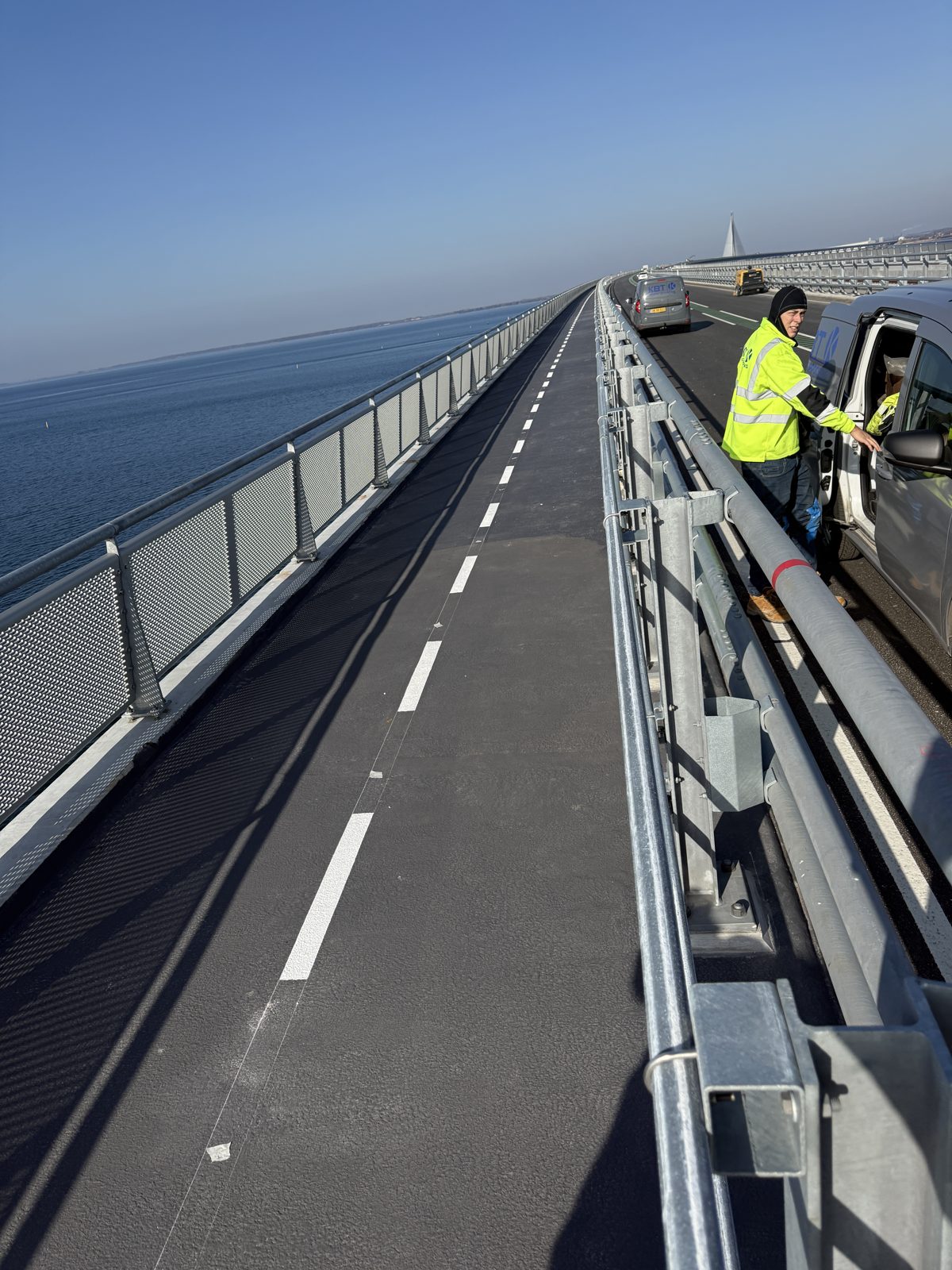
Decseal Wearing Course is an acrylic-based wearing course with anti-slip aggregate mixed into the material. On the Storstrøm Bridge it was laid on top of the membrane on the cycle path from 8 September to 13 October 2025, in grey, with 15,000 m² of Decseal in total on the project. Where the substrate was too uneven, a levelling layer was applied first. The result is a watertight, slip-resistant and hard-wearing surface without asphalt, which weighs less and can be checked with the same pull-off tests as the membrane.
Read more in the blog post Decseal Wearing Course on footways and cycle paths (in Danish).
Timeline
| Period | Work |
|---|---|
| 2018 | 500 m² trial area at the underpass in Orehoved for SBJV |
| Sep.–Oct. 2022 | Tender, documentation package and pull-off tests on the first five bridge girders |
| Nov. 2022 | First girders waterproofed on land on Masnedø at 5–7 °C |
| May–Nov. 2023 | Girders on land and underpasses |
| Sep. 2024 – Jan. 2025 | Railway on the bridge, including through the winter |
| Mar.–Jun. 2025 | Emergency walkways |
| 24 Apr. – 1 May 2025 | Northern carriageway, 15,360 m², of which 3,840 m² on 25 April |
| May 2025 | Southern carriageway and remaining railway |
| Sep.–Oct. 2025 | Decseal on the cycle path |
| Mar. 2026 | Final account and final remedial works |
Challenge · Solution · Result
Challenge
A bridge with a 120-year design life over open water, four areas each with its own build-up, work both on land and out on the bridge, and a programme that required application through two winters. The waterproofing did not just have to be watertight at handover: its watertightness had to be documented, girder by girder.
Solution
KBT Type 5 was sprayed in two colour-coded layers, with a build-up tailored to the road, railway, emergency walkway and cycle path. A separate QA crew measured climate, wet film, adhesion and continuity behind the spray crew, and each girder received its own QA report the following day. A capacity of more than 3,000 m² a day made it possible to make full use of good weather windows.
Result
98,000 m² of membrane and 15,000 m² of Decseal, documented in one QA report per girder. Average adhesion of 2.85 MPa against a requirement of 2.0 MPa, holiday testing at 12 kV across the entire area and a record day of 3,840 m². The client and main contractor have audit-proof documentation of every square metre beneath the asphalt, track and cycle path.
Video: the case in one minute
1 min 7 sec: scope, build-up, the record day and verification on the Storstrøm Bridge (Queen Margrethe II's Bridge).
Photos from the works
Frequently asked questions
How many m² did KBT waterproof on the Storstrøm Bridge?
KBT waterproofed 98,000 m² with KBT Type 5, spread across the carriageway, railway, emergency walkways and cycle path. The footway and cycle path also received 15,000 m² of Decseal Wearing Course as a slip-resistant wearing course.
What was the highest daily output on the Storstrøm Bridge?
On 25 April 2025, four road girders of 960 m² each received the full system (shot blasting, primer, yellow and white layers and bond coat), a total of 3,840 m² in one day. The entire northern carriageway, 15,360 m², was completed between 24 April and 1 May 2025.
How was the membrane verified?
With climate measurement, wet film checks, pull-off tests before and after application (at least 3 per 500 m²) and a holiday test (spark test) at 12 kV across the entire area. In 61 QA reports from 2024–25, 409 pull-off tests were recorded with an average of 2.85 MPa, and all 789 holidays (pinholes) were repaired and retested.
Can Eliminator be applied in winter?
Yes. The manufacturer permits −10 °C; the project required at least +4 °C and 3 °C above the dew point. KBT completed railway girders in November 2024 and January 2025 at outdoor temperatures of 3–6 °C, using tents, drying and climate measurement for every layer.
What is the Storstrøm Bridge called today?
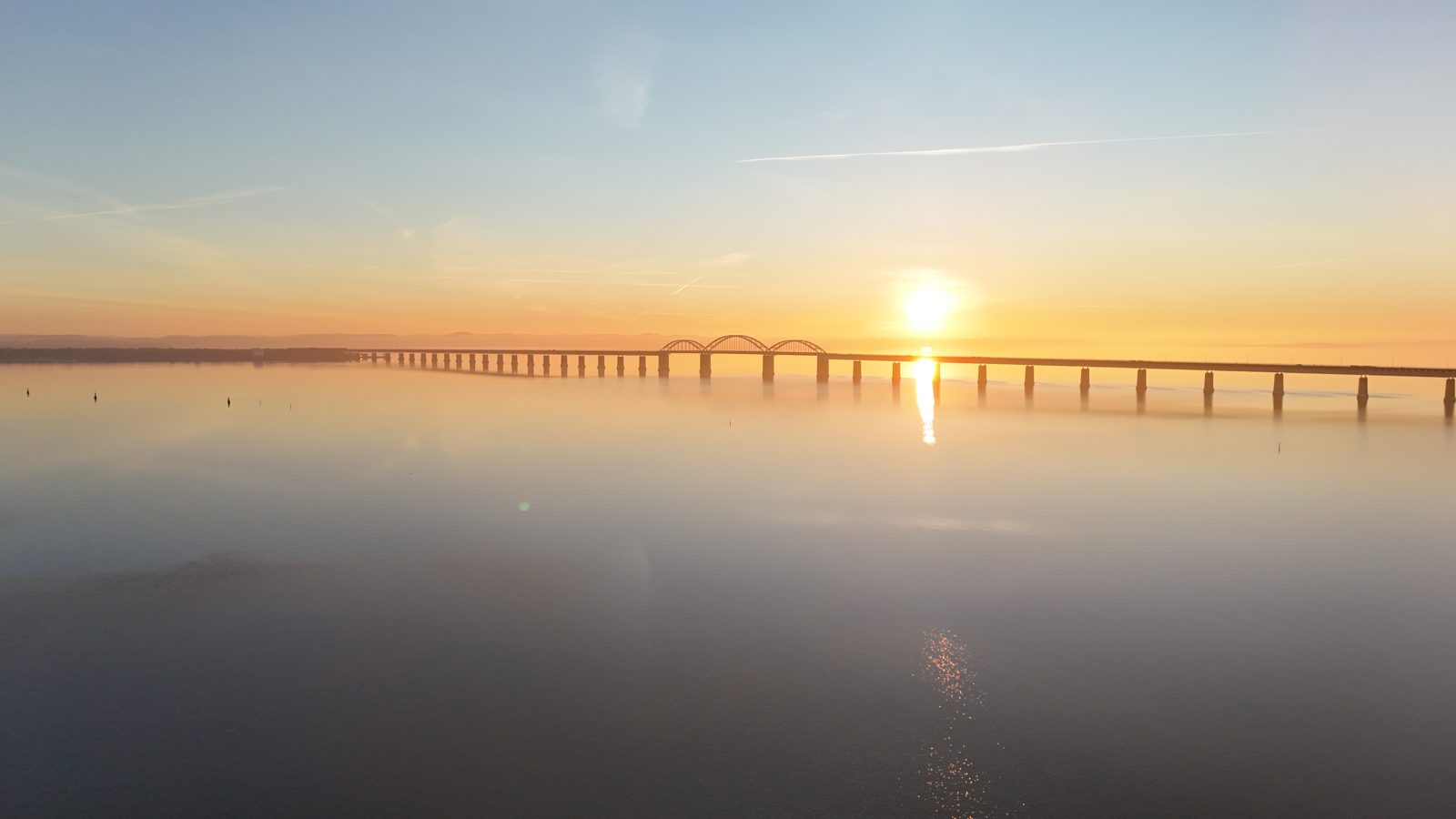
The bridge has been named Queen Margrethe II's Bridge (Dronning Margrethe II's Bro). During construction it was called the Storstrøm Bridge (Storstrømsbroen), and that is the name used in KBT's contract and QA documentation.
See also TV 2 Øst's report from the works in TV2 meets KBT Waterproofing on the Storstrøm Bridge (in Danish).
Need your bridge project waterproofed? →Related pages
Contact us for a technical assessment
Whether it is a new bridge, an existing tunnel or a car park deck, describe the structure and we will get back to you within one working day. We answer in English, Danish and Norwegian.
Write to us directly and a specialist will reply, not a system. The email opens with the information we need, so you get a useful answer quickly.
Send an email →Or call: +45 47 17 18 55 ·
We do not use contact forms. Your email is handled as described in our privacy policy (in Danish).