Holiday testing of bridge deck waterproofing membranes: how KBT verifies 100% of the area
A holiday test (spark test) is an electrical continuity test that finds every single pinhole in a finished membrane. KBT tests the entire area, not spot checks, repairs every holiday (pinhole) before the membrane is covered, and records the result in a QA report. That is the difference between assuming a membrane is watertight and knowing it.
Video: the holiday test in a minute and a half
Animation (on-screen text in Danish): how the test finds a pinhole, why the voltage follows the film thickness, what a full test found on Storstrøm Bridge, Kronprins Frederik Bridge and the Ringsted–Fehmarn railway, and how every holiday is closed before the section is released.
What is a holiday test, and how does it work?
The word "holiday" is trade jargon for a spot where the coating has, so to speak, taken time off: a pore, a pinhole, a film that is too thin or an edge that has not been covered. A holiday test, also called a spark test or continuity test, finds them electrically.
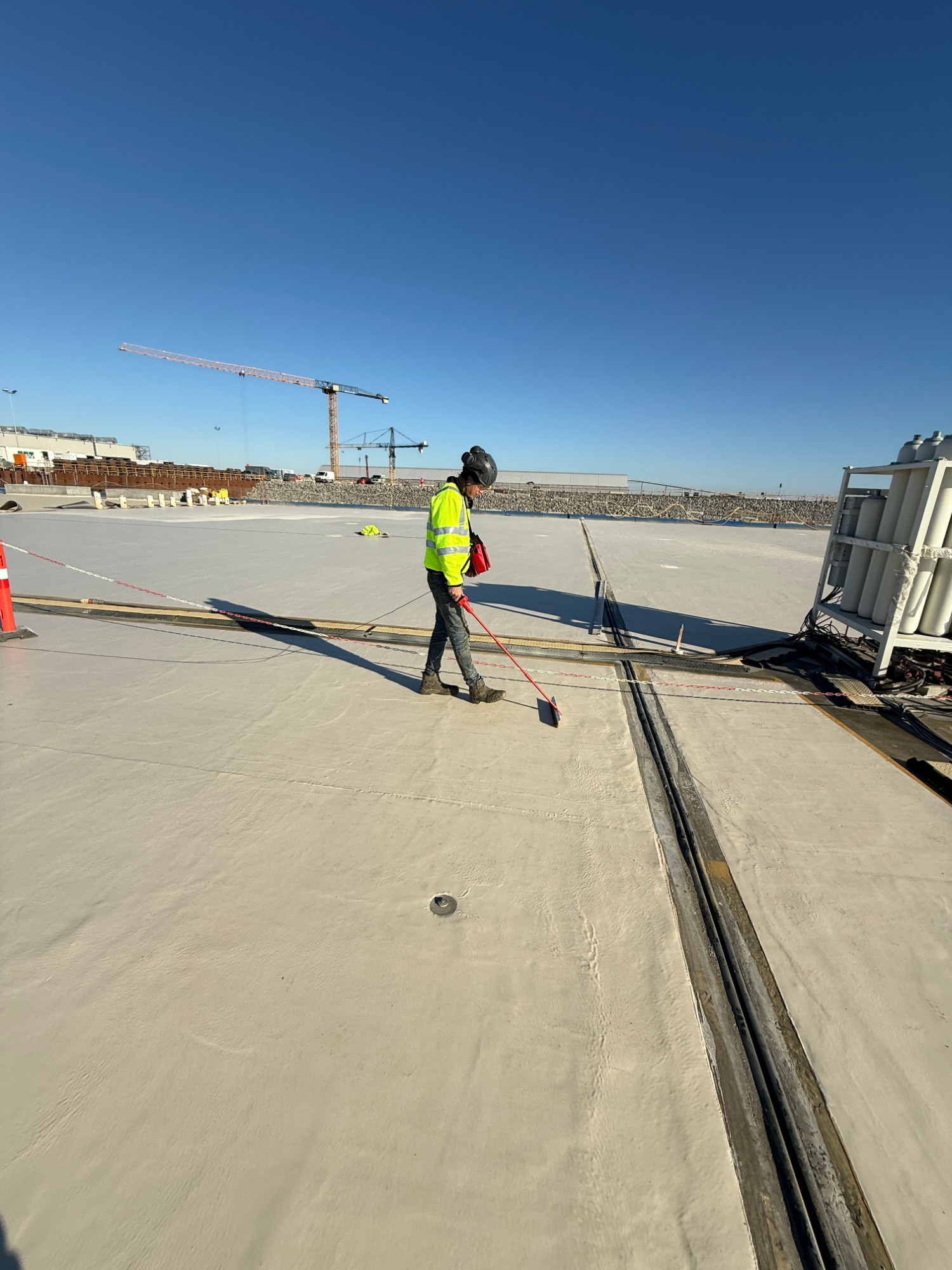
The concrete or steel substrate is earthed. An electrode carrying a high DC voltage, at KBT a brass brush or a conductive rubber brush on a pole, is passed in strips over the entire membrane. As long as the membrane is intact, it insulates and nothing happens. Where the film is broken or too thin, a spark jumps through to the substrate, the circuit is closed and the instrument gives an audible and visual alarm. The spot is marked immediately.
The test works because Eliminator® and other MMA membranes are electrically insulating, whereas concrete and steel are conductive. The thicker the membrane, the higher the voltage needed for a spark to break through at a pinhole. The test voltage is therefore always linked to the total film thickness.
What test voltage does KBT use?
The voltage is set in the method statement for each project on the basis of the membrane's total dry film thickness. If the voltage is too low, pinholes are missed. If it is too high, it can itself create holes in a thin film. KBT's documented practice on Danish bridge projects:
| Project | Membrane thickness | Requirement | Performed at |
|---|---|---|---|
| Kronprins Frederik Bridge, stage 1 (2026) | min. 2.0 mm dry film thickness on steel | 8 kV | 10 kV |
| Storstrøm Bridge (2022–2026) | up to 3.0 mm dry film thickness | entire area | 12 kV |
| Ringsted–Fehmarn railway (2020) | min. 2.0 mm dry film thickness | entire area | According to the project's method statement |
The holiday detector is calibrated annually, and the calibration certificate forms part of the QA report together with the certificates for the climate meter and the pull-off tester.
Why 100% of the area and not spot checks?
Because a bridge deck waterproofing membrane is either watertight or it is not. A single pinhole in 98,000 m² is enough for water and de-icing salt to reach the reinforcement, and that pinhole is never where the spot check is taken. The figures from KBT's own QA reports show how many locations a full test finds:
| Project | Area tested | Holidays found | Repaired and retested |
|---|---|---|---|
| Storstrøm Bridge, 61 QA reports 2024–25 | 38,130 m² | 789 | 789 |
| Kronprins Frederik Bridge, stage 1 | 752.6 m² | 14 | 14 |
| Ringsted–Fehmarn railway, 10 QA reports | over 1,700 m² | 71 | 71 |
This corresponds to one holiday per 25–55 m². The holidays are not a sign of a poor membrane but the expected result of testing the entire surface at high voltage: small pinholes from dust particles, edges at upstands and drains, and places where two strips meet. What matters is that they are found while the membrane is still exposed. Repair takes minutes. The same pinhole discovered after asphalt, protective concrete or ballast has been placed means excavation.
What happens when the test detects a holiday?
- Marking. Every holiday is marked on the membrane immediately and numbered so that it can be located again.
- Repair with the same material. The spot is cleaned, and Eliminator is sprayed or applied in the current colour so that the repair bonds fully to the surrounding membrane. A different product is never used.
- Retest. After curing, the spot is tested again at the same voltage. Only when it is watertight is the section released.
- Photo documentation. Holidays and repairs are photographed and included in the QA report with a time stamp.
The holiday test is the final step: what comes before it?
The holiday test proves that the membrane is continuous. It says nothing about whether the membrane is properly bonded or whether it is thick enough. That is why it is the final step in a process in which every section is released on the basis of measurements:
- Substrate preparation and assessment. Concrete is shot blasted or sandblasted; steel is shot blasted and blown clean. The surface is assessed on KBT's scale and photo-documented.
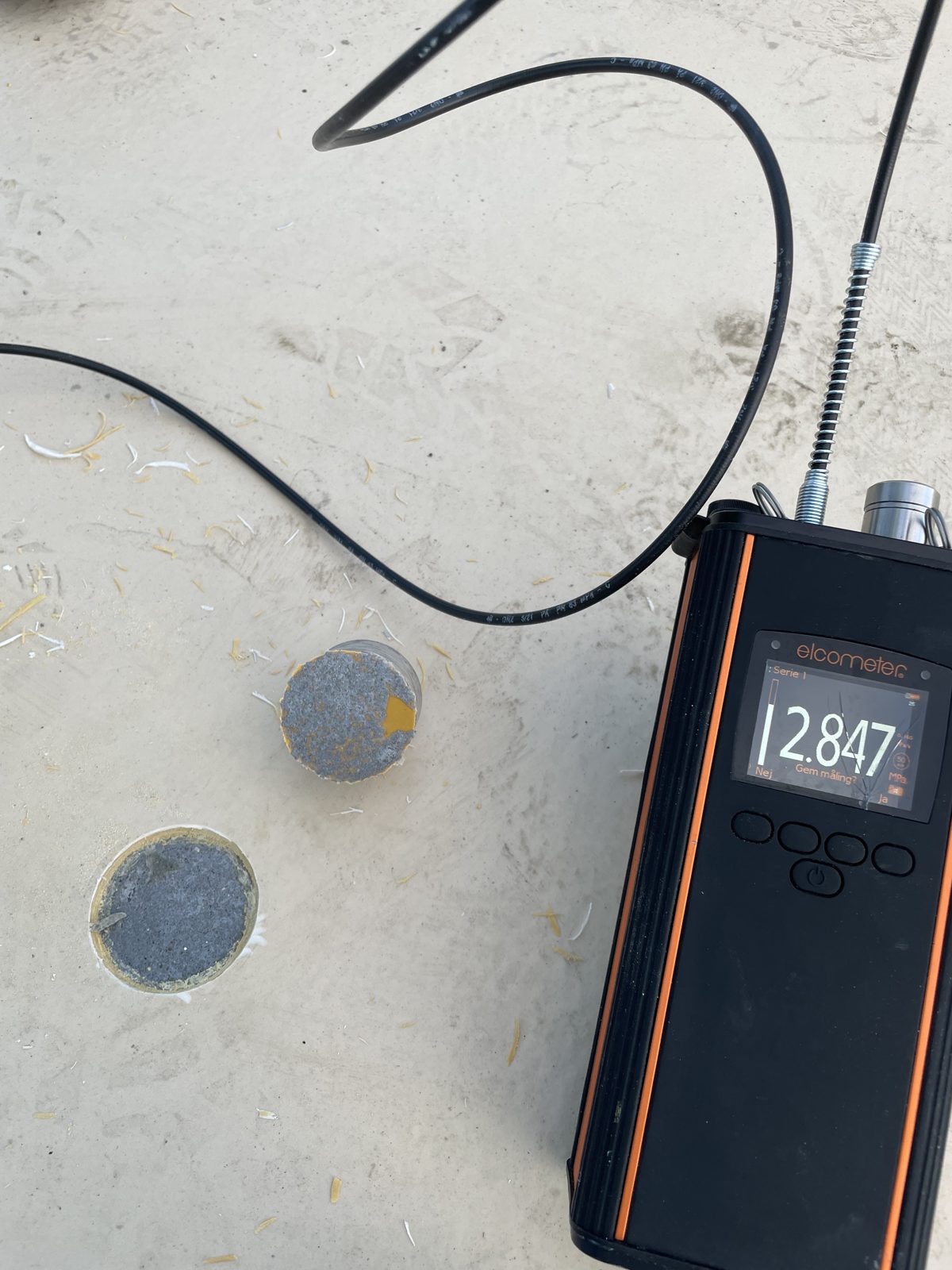
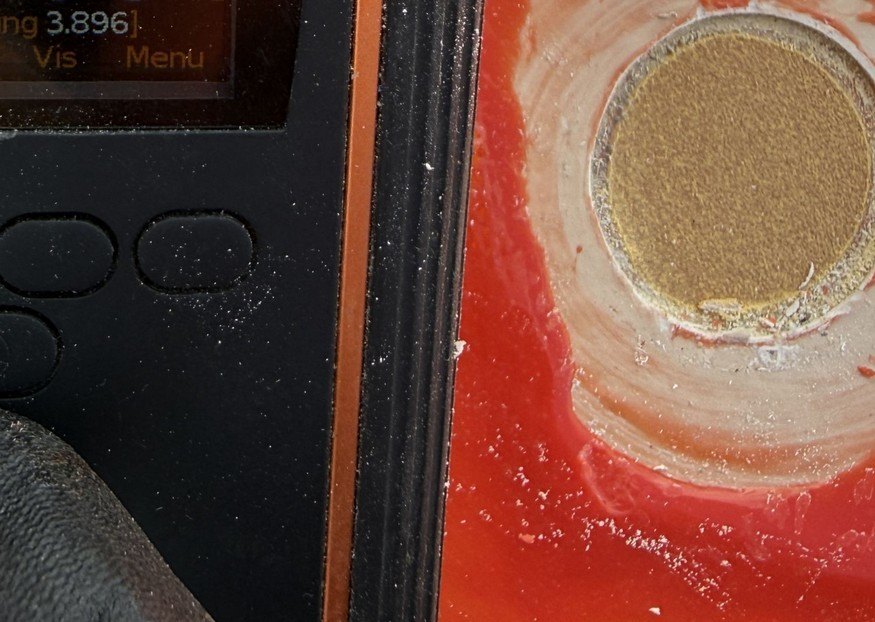
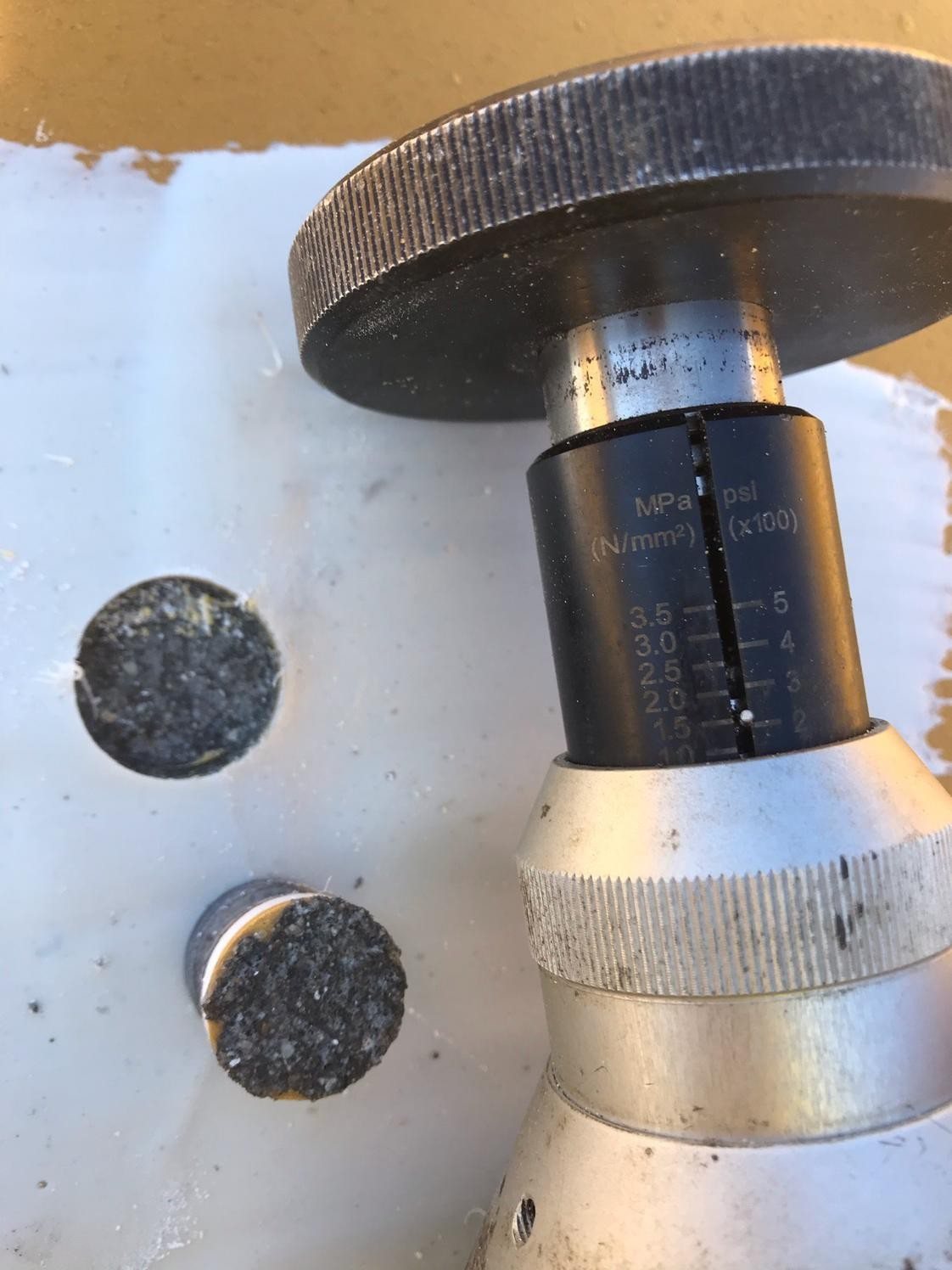
- Pull-off tests before application to EN ISO 4624, at least 3 per 500 m². Typical project requirement: average 2.0 MPa and no single value below 1.5 MPa. The product's declared minimum is 0.7 MPa on concrete and 2 MPa on steel.
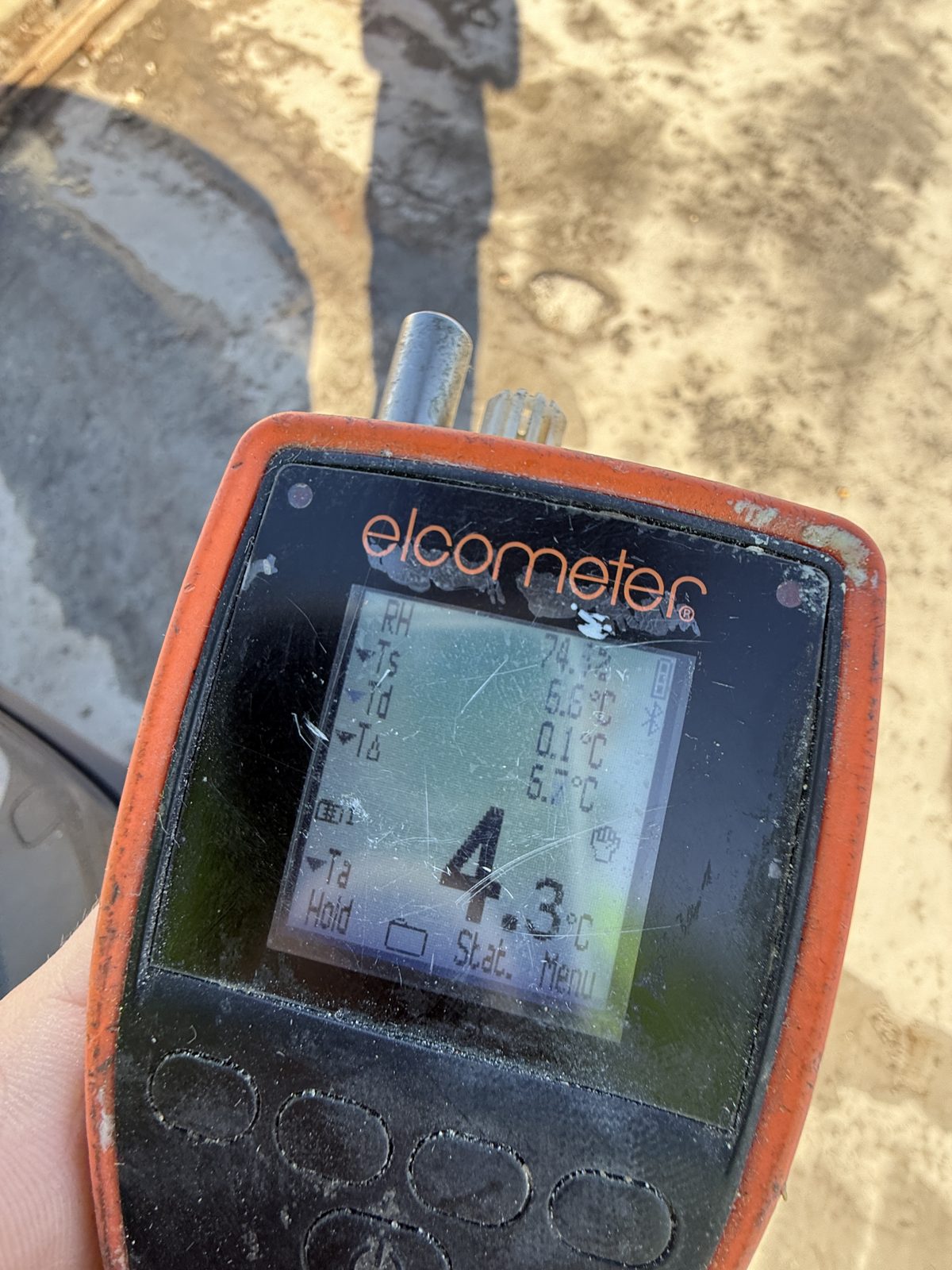
- Climate readings for every coat. Air and surface temperature, relative humidity and dew point are recorded before the primer, yellow coat, white coat and bond coat are applied. The surface must be at least 3 °C above the dew point, the temperature typically between +4 and +30 °C and the relative humidity below 90%.
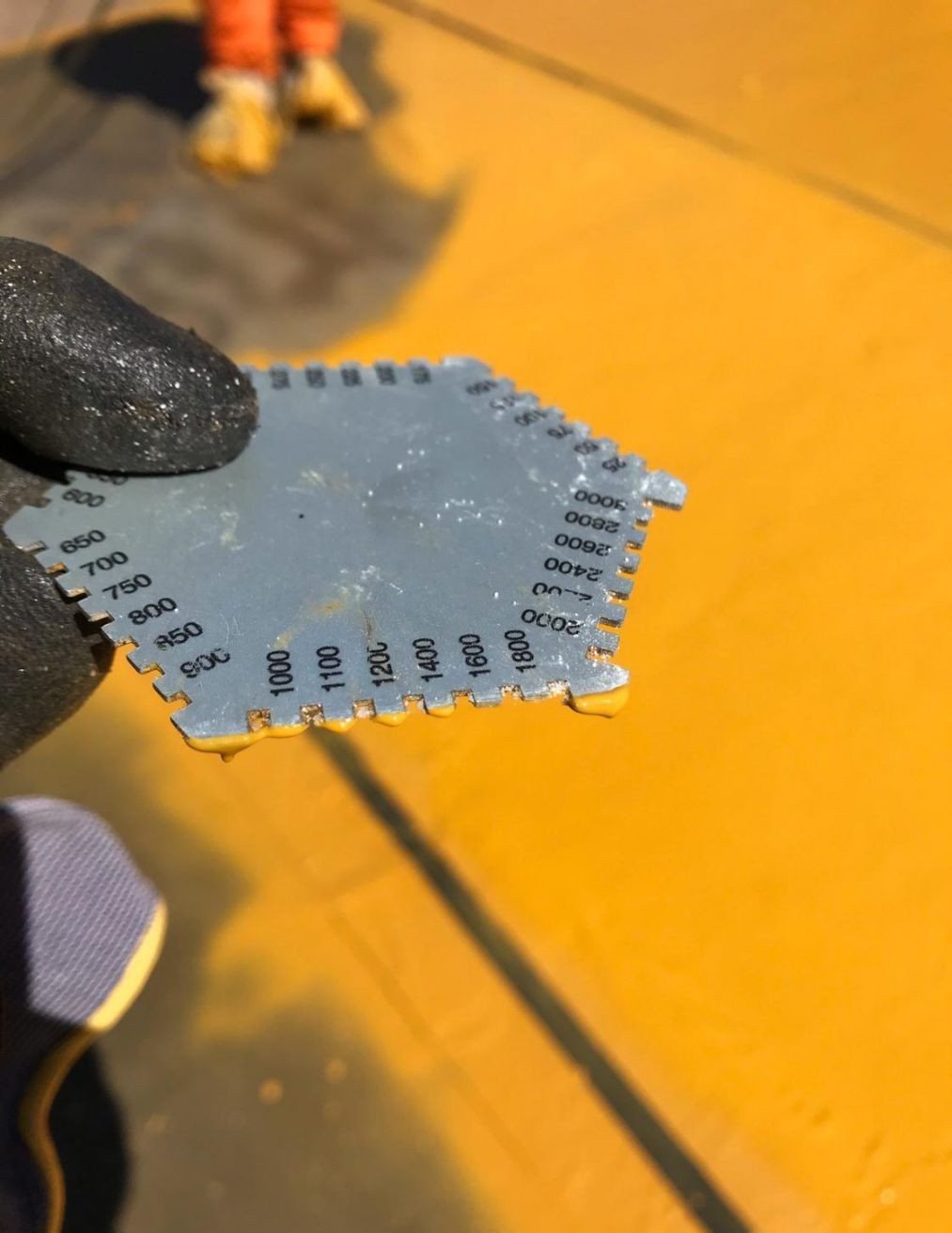
- Application in two colour-coded coats. A yellow first coat and a white second coat. Where the yellow shows through, white is missing. Wet film thickness is checked continuously with a wet film comb.
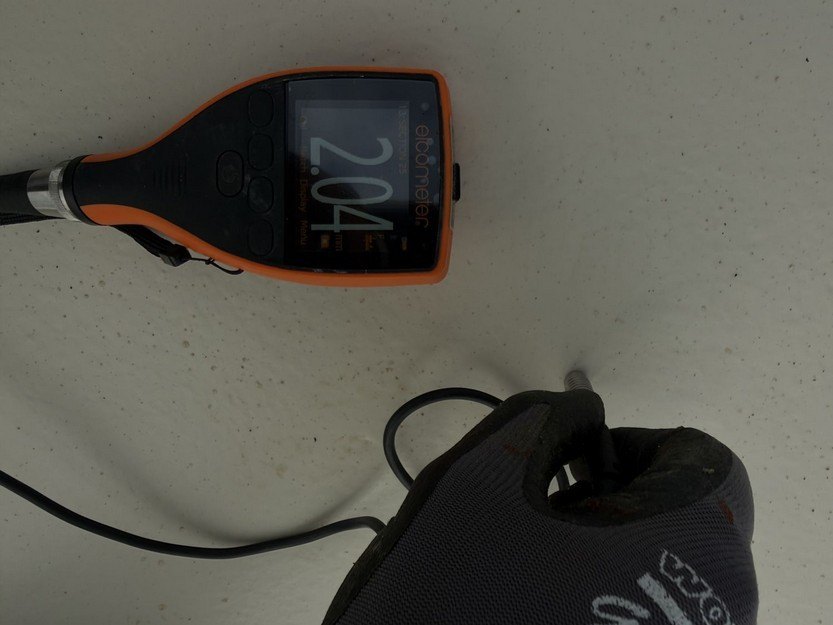
- Dry film thickness is measured on the finished membrane. Requirement typically min. 2.0 mm on concrete.
- Pull-off tests on the finished membrane, 3 per 500 m². The failure must occur in the concrete, not in the bond line between membrane and substrate.
- Holiday test of the entire area at the voltage specified in the method statement.
- QA report per section with all measurements, batch numbers, calibration certificates and photos, handed to the contractor and the client before the section is covered. On Storstrøm Bridge the report was sent no later than the day after the work was carried out.
What is measured, and what are the requirements?
| Substrate | Shot blasting or sandblasting, assessment on KBT's surface scale, photo documentation |
|---|---|
| Adhesion | Pull-off before and after (EN ISO 4624), min. 3 per 500 m². Project requirement typically avg. ≥ 2.0 MPa, min. 1.5 MPa. Declared product minimum: concrete ≥ 0.7 MPa, steel > 2 MPa |
| Climate | Air and surface temperature, RH and dew point for every coat. Surface ≥ 3 °C above dew point, typically +4 to +30 °C, RH < 90% |
| Film thickness | Wet film thickness with a wet film comb during application, dry film thickness on the finished membrane. Requirement typically min. 2.0 mm dry film thickness |
| Continuity | Holiday test of 100% of the area at 8–12 kV according to film thickness. Requirement: no unrepaired holidays |
| Air quality | Measurement of MMA in ppm at 1 and 10 m during spraying |
| Traceability | Batch numbers for primer, Part A, Part B and bond coat are photographed; consumption per m² is recorded against the specified rate |
| Equipment | Holiday detector, Elcometer climate meter and Elcometer pull-off tester, with annual calibration certificates in the report |
Why can injection not be verified in the same way?
Holiday testing, pull-off tests and dry film thickness measurement all require a continuous membrane on an accessible surface. Injection is the opposite: material is pressed into cracks and construction joints inside the concrete, and whether the crack is actually filled and watertight can neither be seen nor measured during execution. The result rests on an expectation that is only confirmed over time.
That is the reason for KBT's position: a membrane is the waterproofing that can be proven, and it belongs on civil engineering projects. Injection is a repair method for existing concrete in service, where a membrane is no longer possible. Read more about injection as a repair method (in Danish).
Photos from the verification
Frequently asked questions
What is a holiday test?
An electrical continuity test of a finished membrane, also called a spark test. An electrode carrying a high DC voltage is passed over the entire surface while the substrate is earthed. Where the membrane is intact, it insulates. At a pinhole or a film that is too thin, a spark jumps through and the instrument sounds an alarm. The holiday is marked, repaired and retested.
What voltage does KBT use for holiday testing?
Typically 8–12 kV, depending on the total thickness of the membrane: 10 kV on Kronprins Frederik Bridge, where the requirement was 8 kV, and 12 kV on Storstrøm Bridge, where the membrane is up to 3 mm thick. The voltage is stated in the method statement for each project.
Why does KBT test 100% of the area rather than spot checks?
Because a single pinhole is enough. On Storstrøm Bridge the test found 789 holidays on 38,130 m², and on Kronprins Frederik Bridge 14 on 752.6 m². A spot check would have missed them. Repair takes minutes while the membrane is exposed; after asphalt or ballast, the same defect means excavation.
Do many holidays mean that the membrane is poor?
No. Holidays are the expected result of testing the entire surface at high voltage and typically come from small pinholes, dust particles or edges. What matters is that every holiday is repaired, retested and recorded in the QA report. A membrane without a holiday test is not a membrane without pinholes, but a membrane in which the pinholes have not been found.
Can injection be holiday tested?
No. The test requires a continuous membrane on a surface the electrode can be passed over. Injection takes place inside the concrete and can neither be seen nor measured electrically. That is why a membrane is KBT's solution for civil engineering projects, and injection only a repair of existing concrete.
When is the holiday test carried out?
After curing and before the membrane is covered by bond coat, asphalt, protective concrete or ballast. It is the last step at which a defect can be corrected without removing anything on top.
Related pages
Contact us for a technical assessment
Whether it is a new bridge, an existing tunnel or a car park deck, describe the structure and we will get back to you within one working day. We answer in English, Danish and Norwegian.
Write to us directly and a specialist will reply, not a system. The email opens with the information we need, so you get a useful answer quickly.
Send an email →Or call: +45 47 17 18 55 ·
We do not use contact forms. Your email is handled as described in our privacy policy (in Danish).