KBT Type 5 bridge deck waterproofing membrane (Eliminator®)
Spray-applied MMA membrane for waterproofing of concrete and steel: bridge decks, steel decks, tunnel elements, base slabs, ground-bearing slabs and technical facilities. Up to 120 years design life, verified during application, not afterwards.
What is the KBT Type 5 bridge deck waterproofing membrane?
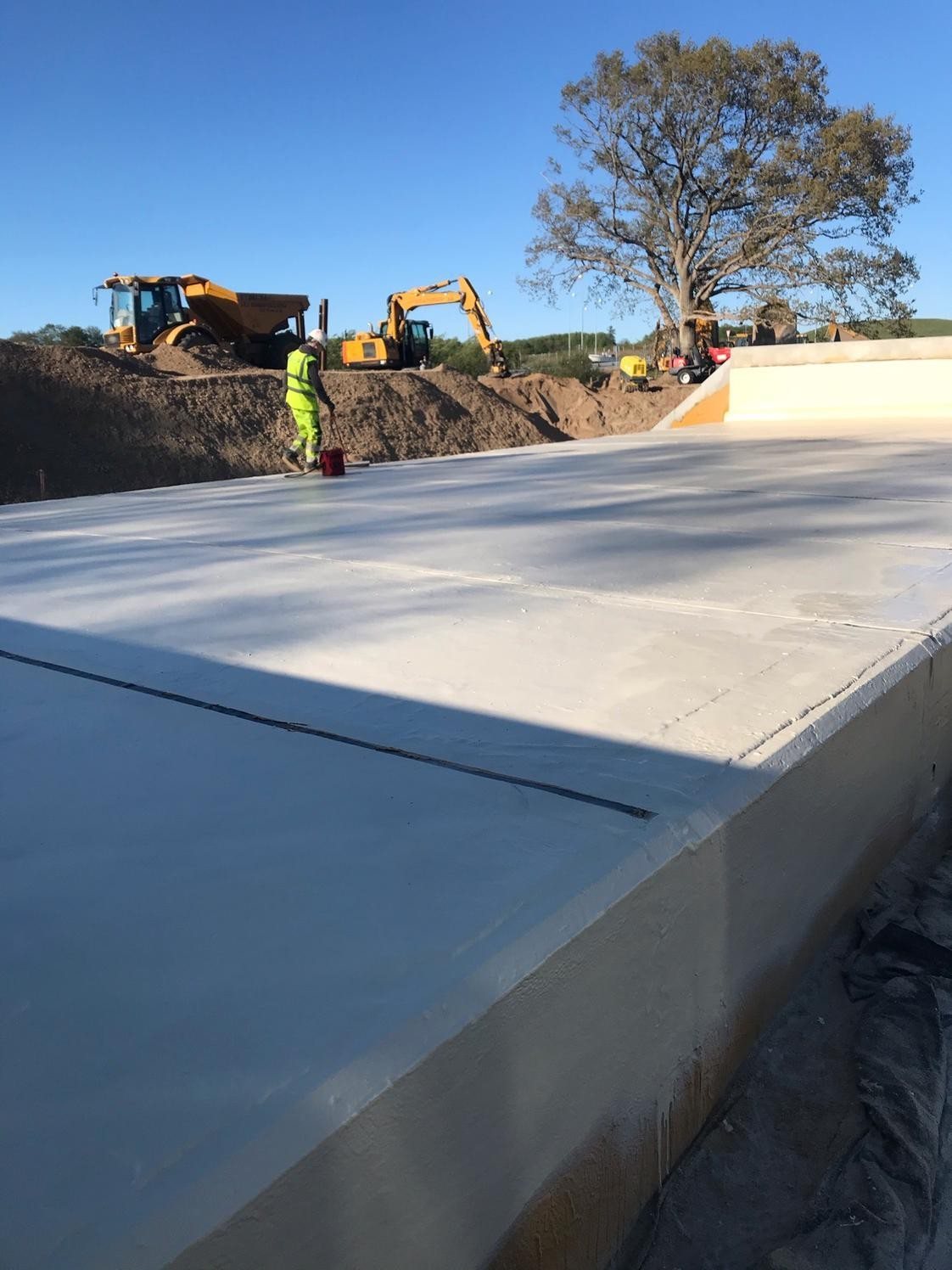
KBT Type 5 is KBT's name for the Eliminator® membrane system: a cold, liquid and spray-applied seamless membrane based on methyl methacrylate (MMA). It is applied in two colour-coded coats with a minimum dry film thickness of 2 mm, without laps and without mechanical fixings. The system is CE marked to EN 1504-2:2004 and holds a European Technical Assessment as a bridge deck waterproofing membrane (ETA-22/0897). The design life is up to 120 years under documented conditions.
The Danish name "bromembran" (bridge membrane) comes from the Danish road standards, where spray-applied waterproofing is designated type V. But the membrane is the same whether the substrate is a bridge deck, a tunnel element, a podium deck in an office building, the floor of a waterworks or a steel deck. In building construction it is called waterproofing of concrete; in the road standards it is called "fugtisolering". The function is the same: a continuous, bonded layer that keeps water and de-icing salt out of the concrete and the reinforcement for the entire service life of the structure.
What sets KBT Type 5 apart from other membranes is not primarily the material. It is that every square metre is measured while it is being applied. Adhesion, thickness and continuity are documented bay by bay before the structure is closed up. The client receives proof of performance, not a guarantee to rely on afterwards.
Key technical data
| Material | MMA-based (methyl methacrylate) reactive membrane, solvent-free |
|---|---|
| CE marking | EN 1504-2:2004, AVCP System 2+, DoP GCPDUK-DP301 |
| European Technical Assessment | ETA-22/0897 from ETA-Danmark as bridge deck waterproofing (EAD 030675-00-0107), DoP GCPDUK-DP401 |
| Notified body | BSI-NL 2797 (certificate 2797-CPR-720819) |
| Minimum dry film thickness | 2 mm, two colour-coded coats |
| Elongation at break | 130 % (ISO 37) |
| Tensile strength | 13 MPa |
| Adhesion to concrete | > 0.7 MPa (EN ISO 4624). Declared in the ETA: 3.7 MPa at standard application and at −10 °C (EN 13596) |
| Adhesion to steel | > 2 MPa (EN ISO 4624) with metal primer, type Vb |
| Temperature | Retains elasticity down to −20 °C; year-round application. UV resistant |
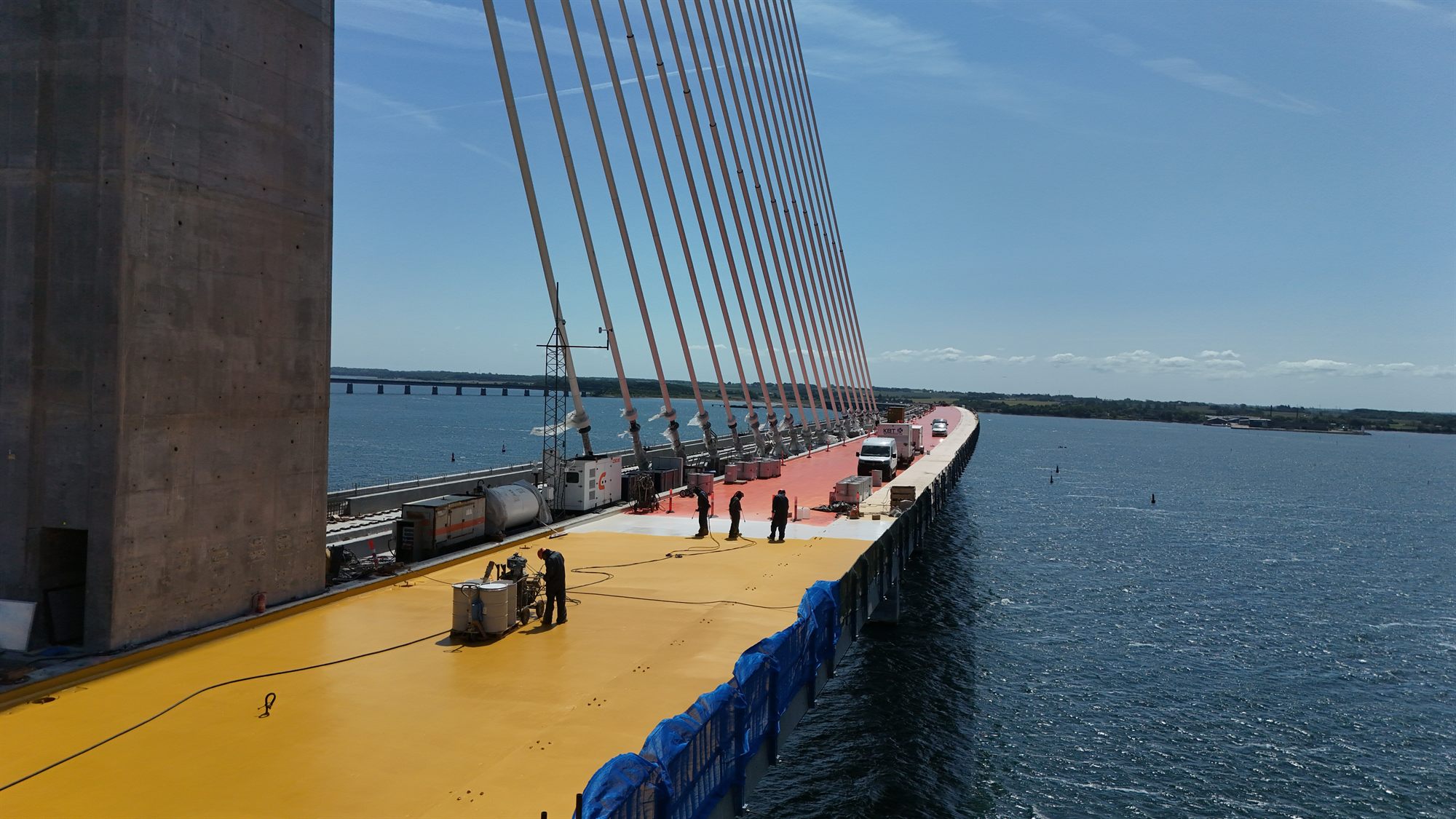
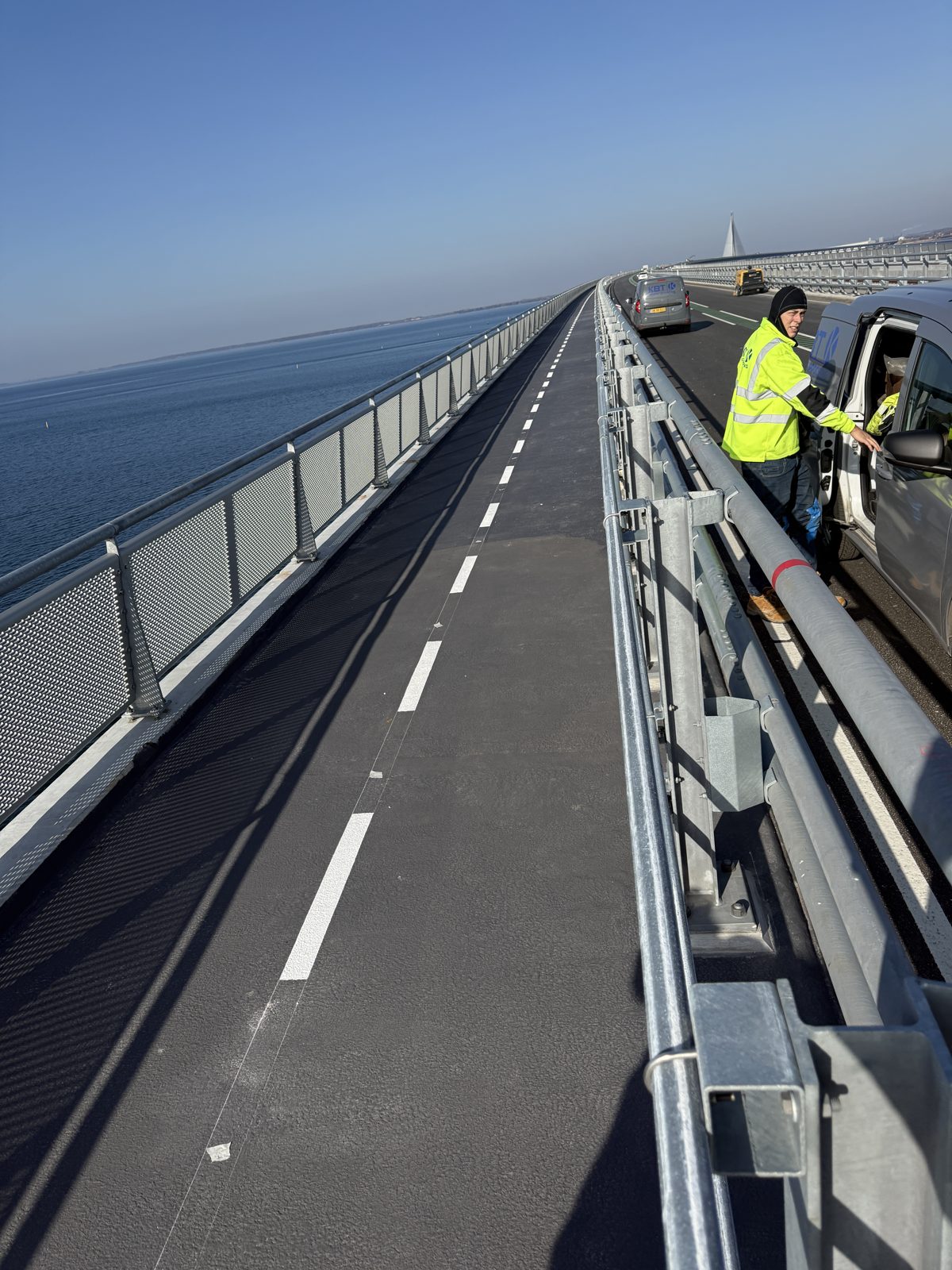
| Application capacity | Over 3,000 m² per day, documented on Storstrøm Bridge (Storstrømsbroen) (2025) |
| Resumption of work | Approx. 1 hour after completed application |
| Design life | Up to 120 years under documented conditions |
| Wearing course | Bond coat for asphalt, protective concrete or ballast; Decseal Wearing Course as a slip-resistant wearing course on footpaths and cycle paths |
| Material supplier | Eliminator® from GCP Applied Technologies (Saint-Gobain group), technology by Stirling Lloyd. Batch number for each delivery |
| Substrate | Concrete and steel, horizontal and vertical surfaces, new and existing structures |
See the full data sheet (in Danish) → · CE, ETA and DoP (in Danish) →
Where is KBT Type 5 used? Waterproofing of concrete and steel
KBT is known for bridges and tunnels, but the membrane is used wherever concrete or steel must be kept dry for many decades and where the client wants watertightness proven rather than promised. All the examples below have been carried out and documented by KBT:
| Concrete bridge decks, road and rail | Storstrøm Bridge (Storstrømsbroen): 98,000 m² on the carriageway, railway, emergency walkways and cycle path, 2022–2026. See the case → |
|---|---|
| Steel decks and steel bridges (type Vb) | Kronprins Frederik Bridge: 752.6 m² of steel deck on the bascule bridge across Roskilde Fjord, 2026, adhesion 2.38 to over 4.0 MPa. See the case (in Danish) → |
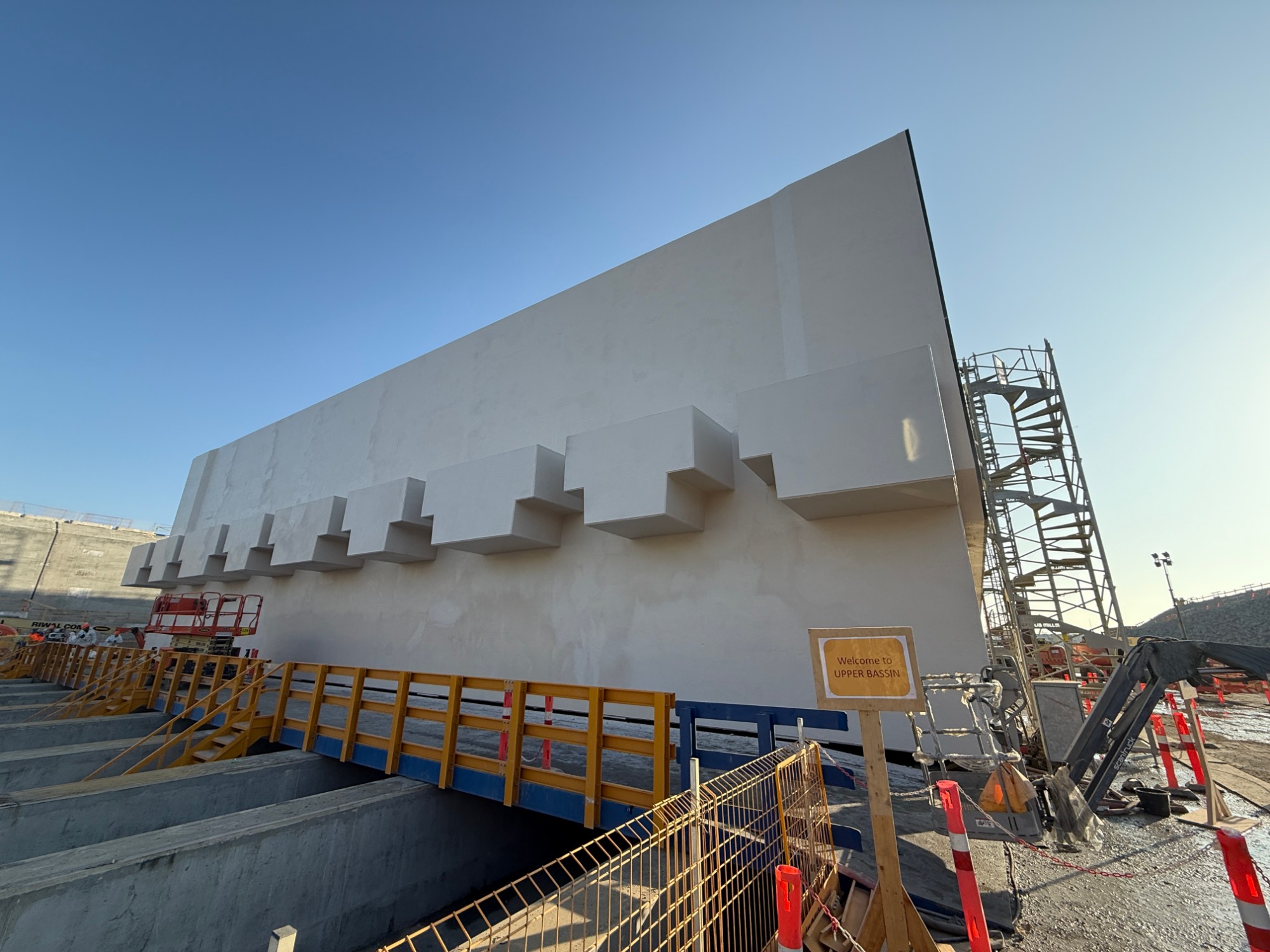
| Tunnel elements | Fehmarnbelt link (Femern-forbindelsen): 60,000 m² on standard elements at the tunnel element factory near Rødbyhavn. See the case (in Danish) → |
| Railway underpasses and wildlife crossings | Ringsted-Femern railway: six underpasses for Banedanmark (Danish rail infrastructure manager), over 1,700 m², 2020. See the case (in Danish) → |
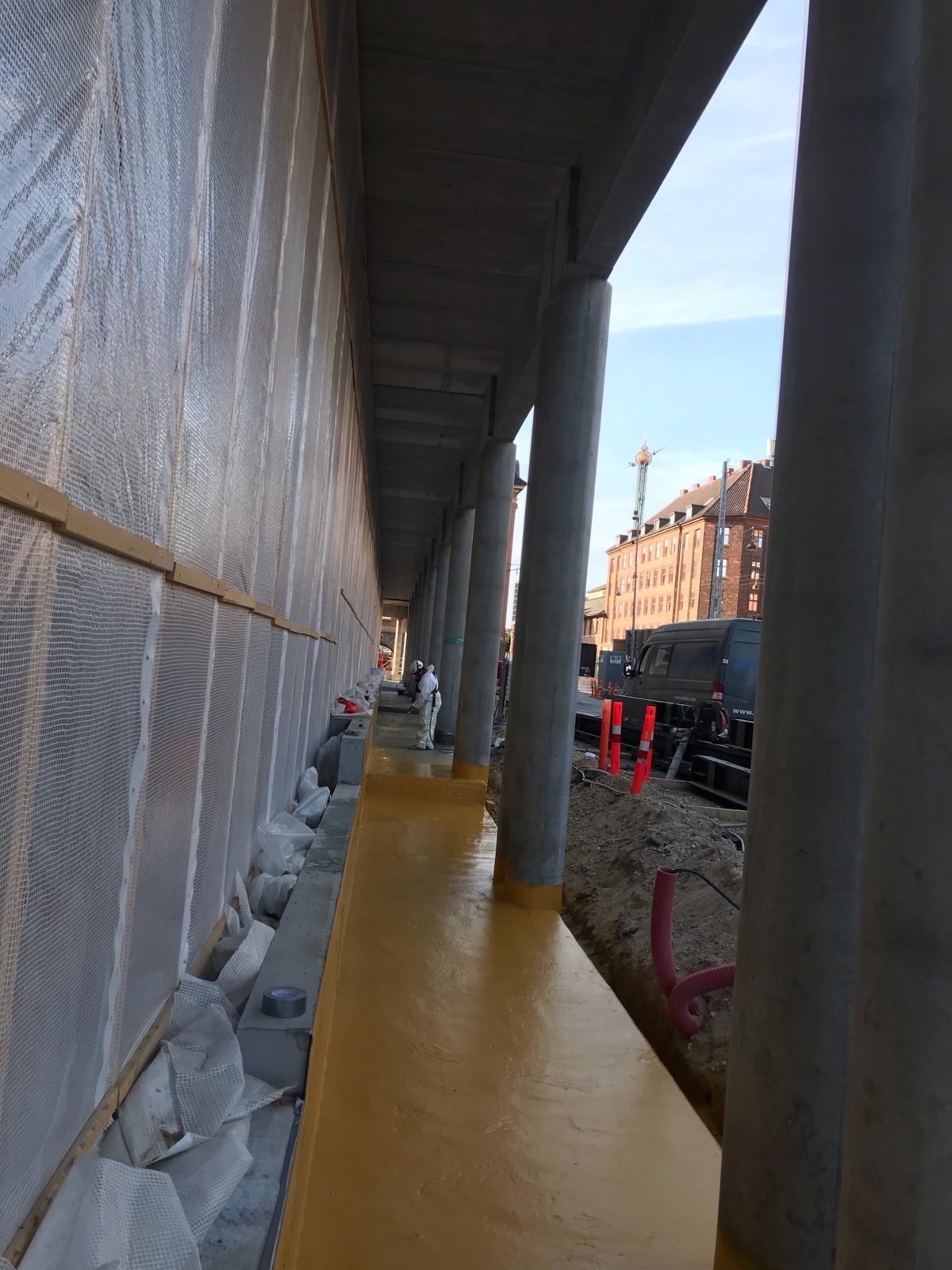
| Ground-bearing slabs and podium decks in buildings | Danske Bank headquarters, Postbyen: 7,500 m² of podium deck above the basement, instead of the roofing felt originally specified. See the case (in Danish) → |
| Waterworks and technical buildings | HOFOR Gevninge waterworks: 584 m² of ground-bearing slab with full QA documentation in two days. See the reference (in Danish) → |
| Footpaths and cycle paths with wearing course | Storstrøm Bridge: 15,000 m² of Decseal Wearing Course directly on the membrane, grey with slip-resistant aggregate. |
| Base slabs below groundwater | Here the membrane must be in place before the concrete is cast. KBT supplies pre-applied Preprufe sheet membrane: Danske Bank headquarters, 18,500 m² under the base slab with 3,150 sealed penetrations. |
| Other surfaces | Emergency walkways, service ducts, arches, upstands and vertical surfaces on concrete and steel. |
Common to all of them: the substrate is assessed and pull-off tested, ambient conditions are measured for each coat, the dry film thickness is checked, and the entire surface is holiday tested before it is covered. The report is delivered for each bay.
Concrete and steel: the difference lies in surface preparation and primer
The membrane is the same on concrete and steel. What changes is the substrate preparation, the primer and the acceptance criterion for adhesion.
| Concrete | Shot blasting or sand blasting to a sound, clean and open surface. Bumps and irregularities are levelled with a levelling coat (zero coat) of membrane material. The substrate must be surface-dry and at least 3 °C above the dew point. PAR1 primer, min. 0.25 kg/m². Product requirement for adhesion: ≥ 0.7 MPa; typical project requirement: average 2.0 MPa, none below 1.5 MPa. The failure must occur in the concrete, not in the bond line. |
|---|---|
| Steel | Shot blasting to bare metal, blowing clean and metal primer before the first coat. The build-up is designated type Vb. Adhesion requirement: over 2 MPa. On Kronprins Frederik Bridge, 22 bumps in the steel deck were levelled with a levelling coat (zero coat) within +0/−5 mm, and the pull-off tests gave 2.38 to over 4.0 MPa. |
| Common to both | Measurement of ambient conditions before each coat (air and surface temperature, relative humidity, dew point), wet film thickness with a comb gauge, dry film thickness min. 2 mm, holiday test of 100 % of the area at 8–12 kV depending on thickness, batch numbers and consumption per m² in the QA report. |
Build-up, coat by coat
| 1. Primer | PAR1 on concrete, metal primer on steel. Bonds the membrane to the substrate |
|---|---|
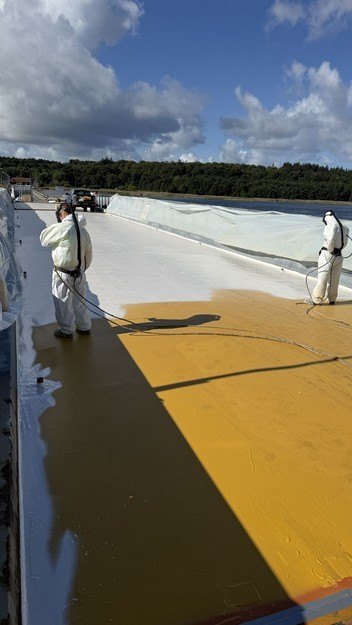
| 2. Eliminator yellow | First coat, sprayed, approx. 1.2 mm. Cures in 30–60 minutes |
| 3. Eliminator white | Second coat, sprayed, approx. 1.2 mm. Where the yellow shows through, white is missing. Total min. 2 mm dry film thickness |
| 4. Bond coat or wearing course | Bond Coat 3 with broadcast sand as the bonding layer for asphalt, protective concrete or ballast. On pedestrian and cycle areas, Decseal Wearing Course directly on the membrane |
Details such as construction joints, expansion joints, upstands and drains receive reinforcing fabric or joint tape in the membrane, and repairs are always made with the same material, so that the repair bonds fully to the surrounding membrane.
What sets Type 5 apart from Type 4 systems?
Type 4 systems, bitumen and epoxy, rely on laps and joints. That is where water gets in, and that is where the repairs follow afterwards. Type 4 systems are repair-dependent: the assumption is that defects will be found when they show themselves.
KBT Type 5 is seamless. The membrane is sprayed on as a continuous layer without joints and without mechanical connections, and the critical functions, adhesion, thickness and continuity, are visible, measurable and tested before the structure is covered. That is the difference between explaining afterwards and demonstrating along the way.
How is KBT Type 5 verified during application?
Every bay goes through the same chain of measurements, and the results are delivered as a QA report to the contractor and the client before the bay is covered:
- Substrate assessment: the surface is assessed and documented with photographs before the first coat is applied
- Pull-off tests to EN ISO 4624 before and after, at least 3 per 500 m²: product requirement > 0.7 MPa on concrete and > 2 MPa on steel, project requirement typically avg. 2.0 MPa
- Measurement of ambient conditions for each coat: temperature, humidity and dew point are logged, with the surface at least 3 °C above the dew point
- Thickness: wet film thickness during application, dry film thickness min. 2 mm on the finished membrane; the two colour-coded coats make missing coverage visible immediately
- Holiday test (spark test) of 100 % of the area: electrical continuity test at 8–12 kV that finds every pore before the structure is closed up. Indications are marked, repaired and retested
On Storstrøm Bridge, this resulted in 409 pull-off tests with an average of 2.85 MPa and 789 holiday indications found and closed in 61 reports. See the holiday test step by step → · KBT's verification method (in Danish) →
How long does KBT Type 5 last?
Up to 120 years under documented conditions: a suitable substrate, verified adhesion, correct build-up and complete continuity documented before the structure is closed up. By comparison, traditional bitumen membranes are expected to last 15–25 years, cementitious waterproofing 10–20 years and PVC/TPO membranes 20–30 years.
A 120-year membrane means fewer replacements, less material consumption and fewer closures of the bridge or building over the service life of the structure, and therefore a lower CO₂ footprint. Calculate the environmental benefit for your project (in Danish) →
How quickly can work continue?
Approx. 1 hour after completed application under verified conditions. KBT has documented over 3,000 m² per day on Storstrøm Bridge (2025) and around 1,000 m² in one day on Danske Bank's podium deck, and the membrane can be applied all year round, including at low temperatures and high humidity, when bitumen-based systems have to wait. On a bridge, this means shorter closure periods; on a building project, it means the next trade can start the same day.
When is a spray-applied membrane not the right choice?
A spray-applied membrane requires a finished concrete or steel surface on which it can be applied and measured. Two situations fall outside this:
Under the base slab. Here the membrane must be laid on the blinding before the reinforcement and concrete are placed, and it cannot be sprayed afterwards. KBT supplies pre-applied Preprufe sheet membrane for base slabs and basement walls, which is cast against and bonds to the fresh concrete. At Danske Bank's headquarters, KBT laid 18,500 m² of Preprufe under the base slab and Type 5 on the podium deck above, the right system for each surface.
Existing concrete in service without access to the surface. A basement car park or a plant room that is already leaking and cannot be emptied cannot be given a membrane. Here, injection (in Danish) is a repair method. But it cannot be verified during execution and never belongs as waterproofing in a new construction project.
Why a membrane rather than injection?
Because a membrane can be verified while it is being applied. Injection can be documented (material, pressure and quantities), but no one can measure whether a crack has been filled along its full extent. That is why KBT Type 5 is always KBT's primary solution for new and refurbished structures, while injection is a repair method for existing concrete in service. KBT considers it irresponsible to plan injection as part of the waterproofing in a construction project.
See the comparison of what can be measured (in Danish) → · Read about injection as a repair method (in Danish) →
Where has KBT Type 5 been used?
KBT has applied Type 5 membrane on some of Scandinavia's largest infrastructure projects and on concrete in building construction, all with verification during application. See all references →
The membrane on concrete and steel, bridges and buildings
Key properties
Frequently asked questions about KBT Type 5
Can KBT Type 5 be used to waterproof concrete outside bridges and tunnels?
Yes. The membrane is the same whether the substrate is a bridge deck, a tunnel element, a ground-bearing slab in an office building or the floor of a waterworks. KBT has applied Type 5 to 7,500 m² of podium deck at Danske Bank's headquarters in Postbyen, 584 m² of ground-bearing slab at HOFOR's waterworks in Gevninge and 60,000 m² of tunnel elements for the Fehmarnbelt link (Femern-forbindelsen). The requirement is a sound concrete or steel substrate that the membrane can bond to and that can be measured.
Can the membrane be applied to steel?
Yes. On steel, the surface is shot blasted to bare metal, a metal primer is applied, and the membrane is built up as type Vb with two coats of Eliminator and a bond coat for the surfacing. The adhesion requirement on steel is over 2 MPa. On Kronprins Frederik Bridge, KBT measured 2.38 to over 4.0 MPa on 752.6 m² of steel deck in 2026.
Is "fugtisolering" the same as waterproofing?
In practice, yes. The Danish road standards call the membrane on a bridge deck "fugtisolering", while in building construction the term is waterproofing of concrete. The function is the same: a continuous, bonded membrane that keeps water and de-icing salt out of the concrete and the reinforcement. KBT Type 5 is used for both and is verified in the same way.
What is the difference between a Type 5 and a Type 4 bridge deck waterproofing membrane?
Type 4 systems (bitumen, epoxy) rely on laps and joints, which are the weak points where water gets in and which are repaired reactively. KBT Type 5 is a seamless, spray-applied MMA membrane without mechanical connections, and every square metre can be measured for adhesion, thickness and continuity before the structure is closed up.
How long does the KBT Type 5 bridge deck waterproofing membrane last?
Up to 120 years design life under documented conditions: a suitable substrate, verified adhesion (> 0.7 MPa on concrete, > 2 MPa on steel), correct build-up (min. 2 mm dry film thickness) and complete continuity documented with a holiday test (spark test) before the structure is closed up. Traditional bitumen membranes are expected to last 15–25 years.
Can KBT Type 5 be applied in winter?
Yes. The membrane is cold-applied, cures chemically in 30–60 minutes and has a declared adhesion to concrete of 3.7 MPa when applied at −10 °C. On Storstrøm Bridge (Storstrømsbroen), KBT applied membrane at 3–6 °C through two winters. The surface must be dry and at least 3 °C above the dew point, and ambient conditions are measured and logged before each coat.
Can vehicles or pedestrians travel directly on the membrane?
The membrane is not itself the wearing course. On road and rail bridges, a bond coat and asphalt, protective concrete or ballast is placed on top. On footpaths and cycle paths, emergency walkways and similar, KBT can apply Decseal Wearing Course directly on the membrane as a slip-resistant wearing course, as on the 15,000 m² cycle path on Storstrøm Bridge. Work on top can resume approx. 1 hour after application.
When is a spray-applied membrane not the right choice?
Under a base slab, where the membrane must be in place before the concrete is cast: here KBT supplies pre-applied Preprufe sheet membrane, as at Danske Bank's headquarters (18,500 m²). And in existing structures in service where there is no access to apply a membrane: here injection is a repair method, but it cannot be verified during execution and is never a solution for new construction.
Does your concrete or steel need a membrane that can be proven?
Bridge, tunnel, base slab, ground-bearing slab or technical facility: send a description of the structure, and KBT will respond within one working day with a technical dialogue on the system and the verification plan.
Contact KBT → Data sheet (in Danish) → CE documentation (in Danish) →